

Types of Home Elevators: A Complete Guide to Residential Elevator Options

On this page
Quick Answer
There are five main types of home elevators: pneumatic (vacuum), hydraulic, traction (cable), shaftless, and through-floor lifts. Each uses a different drive system and fits different homes. Pneumatic elevators are best for retrofits and homes with limited space. Hydraulic elevators are best for larger custom homes needing high capacity. Traction elevators offer smooth rides in new construction. Shaftless elevators work for two-story homes without room for a full shaft. Through-floor lifts serve one specific floor-to-floor transition for accessibility.
How to Use This Guide
If you’re planning a home elevator, the first decision is which type of elevator fits your home, your budget, and how you’ll use it. Every other decision (which model, which finish, where to install it) flows from that.
This guide walks through the five main types of residential elevators, how each one works, what it costs, how much space it needs, and which homes it fits best. It’s built for homeowners at the research stage, not manufacturers or installers. By the end, you’ll know which type of home elevator is worth exploring further and which ones to rule out.
The Five Main Types of Home Elevators
| Type | Drive System | Best Fit | Typical Cost Range | Install Time |
|---|---|---|---|---|
| Pneumatic (Vacuum) | Air pressure | Retrofits, slab foundations, tight spaces | $35,000 to $100,000+ | 2 to 3 days |
| Hydraulic | Fluid-driven piston | Larger custom homes, high capacity needs | $30,000 to $70,000+ | 4 to 8 weeks |
| Traction (Cable) | Steel ropes and sheave | New construction, higher travel distances | $40,000 to $80,000+ | Several weeks |
| Shaftless | Screw-drive or winding drum | Two-story homes without room for a shaft | $20,000 to $40,000+ | 1 to 2 weeks |
| Through-Floor Lift | Screw-drive or hydraulic | Single floor-to-floor accessibility need | $15,000 to $30,000+ | 2 to 5 days |
1. Pneumatic (Vacuum) Elevators
Pneumatic vacuum elevators move a cab through a sealed cylindrical shaft using air pressure alone. A vacuum pump at the top of the shaft reduces air pressure above the cab, and the higher pressure below pushes the cab upward. To descend, the pump gradually releases air, and the cab settles down under controlled gravity.
How it works: Air pressure differential. No cables, pistons, counterweights, or hydraulic fluid. The entire drive system sits at the top of the elevator.
Key advantages:
- No pit or machine room required
- Installation typically 2 to 3 days
- Minimal structural modifications
- Well-suited to slab-on-grade homes and retrofits
- Energy-efficient (no power consumption during descent)
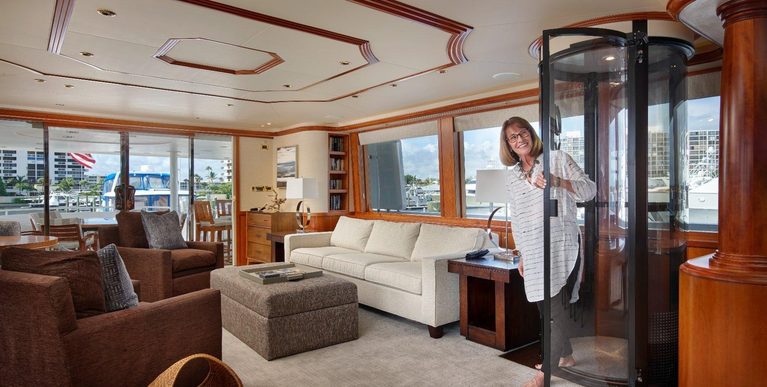
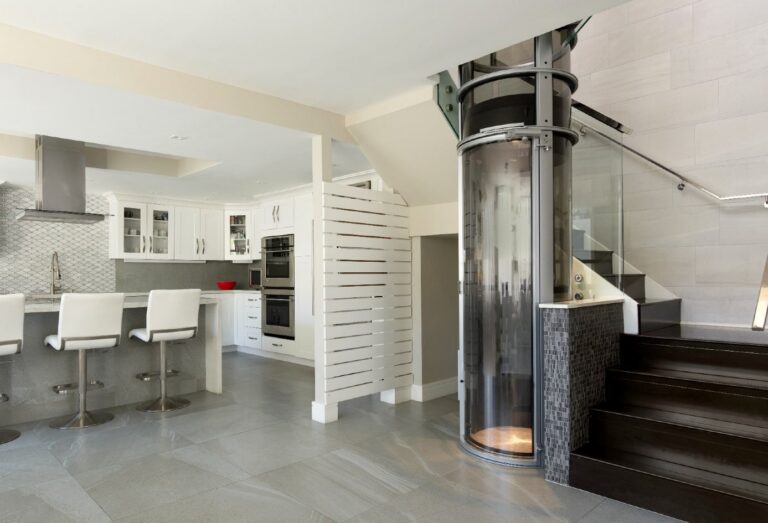
- Cylindrical glass design with 360-degree visibility
Trade-offs:
- Lower capacity than hydraulic (typically 1 to 3 passengers, up to 525 lbs)
- Travel height typically capped around 50 feet
- Cylindrical design may not fit traditional home aesthetics
Best for: Homeowners retrofitting existing homes, homes on slab foundations, tight footprints, and buyers who want fast installation with minimal renovation. PVE offers four pneumatic models: PVE30 (one passenger), PVE37 (two passengers), PVE52 (two to three passengers or wheelchair accessible), and the Cube (rectangular footprint alternative).
Learn more: how pneumatic vacuum elevators work.
2. Hydraulic Elevators
Hydraulic elevators use a fluid-driven piston to raise and lower the cab. An electric pump forces hydraulic fluid into a cylinder, which extends a piston beneath the cab and pushes it upward. To descend, valves release fluid back into a reservoir, and the cab lowers under its own weight.
How it works: Fluid-driven piston beneath (or beside) the cab, powered by an electric pump. Requires a machine room and, for most configurations, a pit.
Three main variants:
- Holed hydraulic: Piston set into a drilled pit beneath the cab
- Holeless hydraulic: Piston mounted alongside the cab (no drilled pit needed)
- Roped hydraulic: Piston plus a pulley system for greater travel height
Key advantages:
- Higher weight capacity (750 to 1,000+ lbs)
- Accommodates 4 to 5 passengers or larger loads
- Fully customizable cab finishes
- Higher travel height ceiling
- Long service life with proper maintenance
Trade-offs:
- Requires a machine room and (usually) a pit
- Installation typically 4 to 8 weeks
- Ongoing hydraulic fluid maintenance
- Higher energy consumption than pneumatic
- Larger visual footprint inside the home
Best for: Larger custom homes, buyers who need to carry heavier loads or more than three passengers, homes being built new (where a pit and machine room can be planned in), and traditional or transitional home designs where a fully customizable cab matters.
3. Traction (Cable) Elevators
Traction elevators use steel ropes or belts running over a grooved sheave, usually with a counterweight. Machine-room-less (MRL) versions place the motor inside the hoistway itself, eliminating the need for a separate machine room.
How it works: Steel ropes over a sheave, powered by an electric motor. Counterweight balances the cab for efficient operation.
Key advantages:
- Smooth, quiet ride
- Higher speeds than hydraulic or pneumatic
- Efficient, especially with counterweight-based systems
- Machine-room-less options save space vs. hydraulic
- Well-suited to higher travel distances (multi-story homes)
Trade-offs:
- Requires a constructed shaft and pit
- Higher cost than pneumatic or shaftless
- Complex mechanical system with more moving parts
- Better suited to new construction than retrofit
Best for: New construction projects where the shaft can be planned during framing, multi-story homes with higher travel distances, and homeowners who prioritize ride quality and speed.
4. Shaftless Home Elevators
Shaftless elevators use a screw-drive or winding drum mechanism to move a cab between two floors without a traditional hoistway. The self-supporting design cuts through the floor rather than requiring a framed shaft.
How it works: Screw-drive column or winding drum mechanism moves the cab through a floor cut-out. No traditional hoistway required.
Key advantages:
- No traditional shaft required
- Faster installation than hydraulic or traction
- Lower cost than most other types
- Well-suited to retrofits
- Compact footprint
Trade-offs:
- Typically limited to two floors (some models handle three)
- Lower travel height than other types
- Enclosed cab designs may feel tighter
- Fewer customization options
Best for: Two-story homes where a traditional shaft won’t fit, budget-conscious retrofits, and homeowners who need reliable floor-to-floor transportation without major renovation.
5. Through-Floor Lifts
Through-floor lifts serve one specific floor-to-floor transition, typically for accessibility. They’re closer in scale to a residential platform lift than a traditional elevator, but they carry passengers through a floor cut-out between two levels.
How it works: Screw-drive or compact hydraulic mechanism moves a platform or small cab through a single floor opening.
Key advantages:
- Lowest cost of any home elevator type
- Fastest installation
- Purpose-built for accessibility
- Minimal structural modifications
Trade-offs:
- Serves only two floors
- Limited capacity (typically one passenger plus wheelchair)
- Aesthetic often feels utilitarian rather than integrated
- Not suitable for multi-story homes or general household use
Best for: Single-user accessibility needs, older adults or wheelchair users who need reliable transit between two specific floors, and situations where a full elevator isn’t necessary.
How Home Elevator Types Compare
By Space Requirements
- Smallest footprint: Pneumatic (compact cylindrical shaft, no pit or machine room)
- Medium footprint: Shaftless, through-floor
- Largest footprint: Hydraulic, traction (require pit and/or machine room)
By Installation Speed
- Fastest: Pneumatic (2 to 3 days), through-floor (2 to 5 days)
- Medium: Shaftless (1 to 2 weeks)
- Slowest: Hydraulic and traction (4 to 8 weeks with excavation and machine room build-out)
By Capacity
- Highest capacity: Hydraulic and traction (750 to 1,000+ lbs, 4 to 5 passengers)
- Medium capacity: Pneumatic PVE52 (up to 525 lbs, 2 to 3 passengers)
- Lowest capacity: Through-floor lifts (typically one passenger)
By Cost
- Lowest: Through-floor lifts and shaftless elevators
- Mid-range: Hydraulic (varies widely by variant), pneumatic
- Highest: Traction, custom hydraulic with premium finishes
For a full pricing breakdown, see our complete home elevator cost guide.
Which Type Fits Which Home?
Existing two-story home, limited space: Pneumatic (PVE30 or PVE37) or shaftless. Both avoid the pit and machine room requirements that make hydraulic and traction difficult in retrofits.
New construction, generous floor plan: Hydraulic or traction. If you’re building from scratch, you can plan the pit, shaft, and machine room during framing, which unlocks higher capacity and travel height.
Wheelchair user or mobility aid required: Pneumatic PVE52 (up to 525 lbs, wheelchair accessible), the Cube, or a larger hydraulic cab. Focus on door width, cab dimensions, and turning space.
Design-focused luxury home: Panoramic pneumatic vacuum elevator, or a custom hydraulic with glass panels. Aesthetic priorities often decide the type.
Budget-conscious retrofit: Shaftless elevator or compact pneumatic. Both reduce major structural changes.
Single accessibility need between two floors: Through-floor lift or shaftless elevator. A full home elevator may be more than you need.
How to Choose the Right Type for Your Home
Once you know which types exist, the next question is which one actually fits your home, budget, and long-term needs. That decision depends on your home’s construction (slab vs. basement), how many people will use the elevator, capacity needs, timeline, and aesthetic preferences.
For head-to-head comparisons between the two most common types, see: Pneumatic vs Hydraulic Home Elevators.
Why Homeowners Choose Pneumatic (PVE)
Among the five main types, pneumatic vacuum elevators offer the best combination of fast installation, minimal structural change, and design flexibility for most residential applications. PVE pioneered vacuum elevator technology in 2002 and has spent over two decades refining it.
Every PVE elevator is built to A17.7 residential code, installs in days rather than weeks, and comes in four models engineered around real household use cases:
- PVE30: One passenger, smallest footprint
- PVE37: Two passengers, most popular residential configuration
- PVE52: Two to three passengers or wheelchair accessible
- The Cube: Rectangular footprint alternative for homes where a cylindrical shaft doesn’t fit
FAQS
1. What is the most common type of home elevator?
Answer: Pneumatic (vacuum) and hydraulic elevators are the two most common types installed in residential homes today. Hydraulic elevators have been the traditional choice for decades, while pneumatic vacuum elevators have grown rapidly over the past 20 years because they require no pit, no machine room, and install in 2 to 3 days. Traction, shaftless, and through-floor lifts serve more specialized use cases.
2. Which type of home elevator is best for a small home?
Answer: Pneumatic vacuum elevators and shaftless elevators are the best options for smaller homes. Both avoid the large machine room and pit requirements of hydraulic and traction systems. Pneumatic elevators can fit into as little as 7 to 9 square feet of floor space, making them one of the most space-efficient options available.
3. What is the difference between hydraulic and pneumatic elevators?
Answer: Hydraulic elevators use a fluid-driven piston powered by an electric pump, while pneumatic vacuum elevators use air pressure inside a sealed cylindrical shaft. Hydraulic systems have higher weight capacity but require a pit, machine room, and 4 to 8 weeks of installation. Pneumatic systems install in 2 to 3 days with no structural excavation but carry fewer passengers (1 to 3 vs. 4 to 5).
4. Can any type of home elevator be installed in an existing home?
Answer: Not equally. Pneumatic vacuum elevators and shaftless elevators are the easiest to retrofit because they don’t require a pit or machine room. Hydraulic and traction elevators can be installed in existing homes, but they typically require significant renovation to accommodate the pit, shaft, and machine room. If you’re retrofitting a home built on a slab foundation with no basement, pneumatic is usually the most practical option.
5. What type of home elevator is safest?
Answer: All home elevator types are engineered to strict safety standards and include emergency features required by code. Pneumatic vacuum elevators have a passive safe-descent design: if power fails mid-ride, the elevator uses the pressure differential itself to lower to the nearest floor without needing electricity. Hydraulic and traction elevators rely on active safety systems like safety valves and emergency braking. Properly installed and maintained, all types are safe for daily residential use.
6. Which type of home elevator is most energy-efficient?
Answer: Pneumatic vacuum elevators are the most energy-efficient of the common residential types. They consume no power during descent (the cab lowers under controlled air release and gravity), and their overall energy use is significantly lower than hydraulic systems. Some comparisons estimate hydraulic elevators use more than three times the energy of pneumatic systems over a typical ownership period. [verify source]
7. What is the cheapest type of home elevator?
Answer: Through-floor lifts are typically the lowest-cost option, followed by shaftless elevators. However, these systems have significant capacity and travel limitations. Among full-featured home elevators, hydraulic holeless systems and mid-range pneumatic models offer the best balance of cost and function.
Was this article helpful?

Get in touch to schedule a call back
One of our lift experts will answer all of your questions.
Prefer to talk now? (877) 691-0357