
- Quick Answer
- Key Takeaways
- What Is the Typical Speed of a Home Elevator?
- Why Are Home Elevators Slower Than Commercial Elevators?
- How Does Elevator Type Affect Home Elevator Speed?
- How Fast Do PVE Home Elevators Travel?
- How Long Does a Trip Between Floors Take?
- Does Speed Matter When Choosing a Home Elevator?
- Find the Right Home Elevator for Your Home
- Frequently Asked Questions
Quick Answer
Most home elevators travel about 30 to 40 feet per minute, so moving one floor (roughly 10 feet) takes about 15 to 20 seconds of travel time. In the U.S., residential elevators are generally limited to about 40 feet per minute under the ASME A17.1 safety code, though local rules vary.
Key Takeaways
- Most residential elevators travel at 30 to 40 feet per minute. A typical 10-foot floor takes roughly 15 to 20 seconds of travel time.
- ASME A17.1, the U.S. elevator safety code, generally limits residential elevators to about 40 feet per minute. Local codes may set a different limit.
- Hydraulic home elevators usually run about 20 to 40 feet per minute. Pneumatic vacuum elevators, including PVE models, typically run 30 to 40 feet per minute.
- All four PVE models travel at 35 or 40 feet per minute.
- For most households, ride comfort, cab size, and fit in the home matter more than a few extra feet per minute.
What Is the Typical Speed of a Home Elevator?
Most residential elevators in the U.S. travel at roughly 30 to 40 feet per minute, or about 0.15 to 0.5 m/s. Speeds are capped by safety codes, with ASME A17.1 generally limiting residential elevators to about 40 feet per minute. Because local building codes can differ, confirm the permitted speed with your local authority and installer.
In practical terms, 30 to 40 feet per minute feels like a calm, controlled ride. At that pace, you cover a typical floor in about 15 to 20 seconds of motion.
This moderate speed range is intentional. Home elevators are designed to balance comfort, efficiency, and structural constraints, which helps keep the ride smooth and predictable for everyone in the household. A slower elevator can feel more natural than a faster one with abrupt movements.
Why Are Home Elevators Slower Than Commercial Elevators?
Home elevators are deliberately slower than commercial elevators because of residential safety codes, shorter travel distances, and a focus on passenger comfort.
- Safety code limits. The ASME A17.1 code sets a lower speed limit for private residence elevators than for commercial equipment.
- Short trips. Homes have only a few floors. Extra speed would save only a few seconds per trip, and quicker starts and stops can make a ride feel less comfortable.
- Simpler equipment. Faster elevators need more powerful drive systems and components, which a low-rise home does not need.
Commercial buildings need faster elevators to move many people over large vertical distances. A home elevator typically serves a small household across a few floors, so smooth operation and a comfortable ride take priority.
How Does Elevator Type Affect Home Elevator Speed?
The drive system shapes a home elevator’s typical speed, but every type has to stay within the residential code limit. The table below compares the most common types.
| Elevator Type | Typical Speed | How It Moves | What It Needs |
| Hydraulic | About 20 to 40 ft/min | A fluid-driven piston pushes the car | Shaft, pit, and usually a machine room; faster residential installations may require a deeper pit |
| Traction or cable | Near the residential code limit | A motor moves the car with cables or belts | Shaft and space for machinery |
| Pneumatic vacuum (PVE) | 30 to 40 ft/min | Air pressure differences move the car in a sealed cylinder | No pit, shaft, or machine room; self-supporting |
Hydraulic home elevators often sit at the lower to middle end of the residential range. Traction elevators can be engineered for higher speeds, but in homes they operate within the same residential limits as other types. Higher-speed setups can also raise noise and vibration levels, and mechanical noise from mechanical components may become more noticeable in a home.
Many domestic lifts top out around 0.15 m/s, even though some U.S. home elevators are commonly described as 30 to 40 feet per minute.
Pneumatic vacuum elevators move the car by changing the air pressure above it, which lets them start and stop smoothly without a traditional shaft. That design is the core of pneumatic elevator technology, and it is why these systems need no pit or machine room.
When comparing options, look beyond speed. Available space, structural changes, overhead clearance, and long-term maintenance usually make a bigger difference.
How Fast Do PVE Home Elevators Travel?
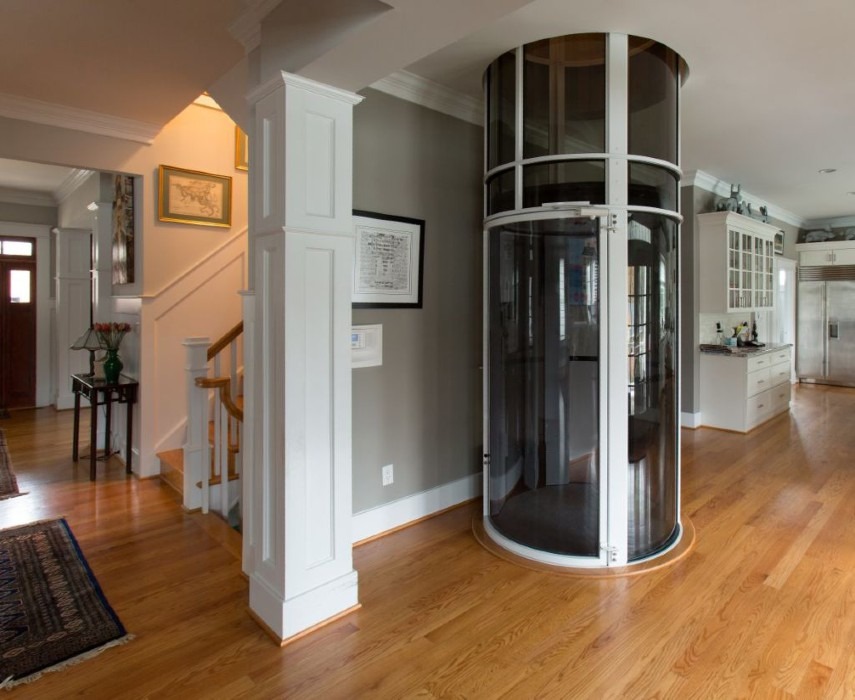
All four PVE models travel at 35 or 40 feet per minute, within the typical residential range.
| Model | Speed | Passengers | Capacity | Max Rise | Stops |
| PVE30 | 40 ft/min | 1 | 350 lbs | 50 ft | 2 to 5 |
| PVE37 | 40 ft/min | 2 | 450 lbs | 50 ft | 2 to 5 |
| PVE52 | 35 ft/min | Wheelchair accessible | 525 lbs | 50 ft | 2 to 5 |
| The Cube | 35 ft/min | 2 | 450 lbs | 35 ft | 2 to 3 |
Every PVE model is self-supporting and needs no pit, shaft, or machine room, and installation typically takes two to three days. Cab sizes, footprints, and clearances for each model are covered in our guide to residential elevator dimensions and space requirements.
How Long Does a Trip Between Floors Take?
At home elevator speeds, a 10-foot rise takes about 15 seconds of travel at 40 feet per minute and about 17 seconds at 35 feet per minute. The full trip takes a few seconds longer once you add the time for doors to open and close and for the car to start.
You can estimate travel time for any home with a simple formula, and you can also use it to calculate elevator speed when you know the rise and elapsed time:
- Travel time (seconds) = (rise in feet ÷ speed in feet per minute) × 60
- Example: A 20-foot rise at 40 feet per minute takes (20 ÷ 40) × 60 = 30 seconds.
To check an existing elevator’s speed, measure the vertical distance of the rise between two landings in feet, time the ride in seconds, and divide the rise by the time in minutes.
The difference between 35 and 40 feet per minute is a couple of seconds per floor, which most riders will not notice.
Does Speed Matter When Choosing a Home Elevator?
For most households, not much. Many domestic lifts and most home elevators are commonly benchmarked around 0.15 m/s, so within the residential range, ride comfort, cab size, accessibility, and fit in the home have a bigger effect on daily use than speed.
- Comfort. Smooth starts and stops matter more than top speed. A slower speed can be easier for children, older adults, and people with reduced mobility, which improves the overall user experience.
- Accessibility. For aging in place, cab size, door configuration, and wheelchair access usually matter more than a small gain in feet per minute, especially when matching features to user needs.
- Number of floors. Speed makes the most difference in homes with three or more stops, and even then the gap is measured in seconds.
- Construction. Whether the system needs a shaft, pit, or machine room affects your project far more than its speed rating.
High-speed elevators exceed 0.6 m/s, but they are rare in residential settings.
Because all four PVE models fall within 35 to 40 feet per minute, most homeowners choose based on capacity, accessibility, and design rather than speed.
Find the Right Home Elevator for Your Home
Start with who will ride the elevator, your daily needs, how many floors you need to connect, and whether you need wheelchair access, since intended use, such as accessibility or everyday convenience, affects the right choice. Then compare drive systems, space requirements, and installation complexity, and have an installer assess the home’s structure and building structure before recommending a system.
PVE’s authorized dealer network can review your floor plan, daily use, and accessibility needs, explain local code requirements, and recommend a model that fits your home.

Frequently Asked Questions
Does a Faster Home Elevator Use More Energy?
Within the narrow residential speed range, faster speeds can increase installation complexity and energy usage, but elevator type and drive system usually matter more in homes for overall energy efficiency. Energy-efficient designs can also lower long-term energy consumption. An authorized dealer can explain the power requirements for a specific model.
Can I Adjust the Speed of My Existing Home Elevator?
Only a qualified elevator professional should change an elevator’s speed, and any change must stay within ASME A17.1, safety regulations, and local code limits. If your elevator seems slower than its rated speed, contact your service provider, since that can be a sign it needs maintenance and can affect cost over time through added service or system changes.
Is There a Minimum Speed for Home Elevators?
Safety codes focus on maximum speed rather than a minimum. Most residential elevators are designed to run within a comfortable range so trips do not feel unusually slow.
How Many Floors Can a PVE Home Elevator Serve?
The PVE30, PVE37, and PVE52 can serve 2 to 5 stops over as much as 50 feet of rise. The Cube serves 2 to 3 stops over up to 35 feet of rise.
What Happens During a Power Outage?
PVE elevators are designed to descend safely to the lowest landing using gravity during a power loss, so passengers are not left between floors. Ask an authorized dealer about emergency procedures for the model you are considering.
Why Do Some Sources List Faster Home Elevator Speeds?
Some manufacturers offer optional higher speeds where local code allows, and some sources mix in commercial or international figures. In the U.S., about 40 feet per minute is the common residential limit, so confirm the permitted speed with your installer.