Skip to content >

- Key Takeaways
- How Many Floors Can A Home Elevator Travel?
- What Limits How High A Home Elevator Can Go?
- How Many Stops Does Each Type Of Residential Elevator Support?
- Can A Pneumatic Home Elevator Serve Three Or More Floors?
- Which Floors Should Your Home Elevator Serve?
- Where Will The Elevator Stop?
- Pve Home Elevator Models And Their Travel Limits
- Do You Need A Pit Or Machine Room For A Multi-Floor Home Elevator?
- How To Decide How Many Floors Your Elevator Should Serve
- How Future-Proof Is A Multi-Floor Home Elevator?
- FAQ
Quick answer: Most home elevators serve two to four floors, and many reach up to 5 stops within about 50 feet of total travel. The PVE30, PVE37, and PVE52 each handle up to 5 stops and 50 ft of travel. The Cube handles up to 3 stops and 35 ft.
If you live in a multi-story home or you are planning one, figuring out how many floors a home elevator can serve is one of the first questions worth answering. The number of stops you need shapes the type of elevator you choose, the structural work required, and ultimately the budget. This guide breaks down the real limits set by equipment, codes, and your home itself so you can plan with confidence.
Key Takeaways
- Most home elevators in the United States serve two to four floors, and many systems reach up to 5 stops within about 50 feet of total travel.
- The PVE30, PVE37, and PVE52 each serve up to 5 stops and up to 50 ft of travel. The Cube serves up to 3 stops and up to 35 ft.
- Shaftless vacuum elevators need no pit, no shaft construction, and no separate machine room, which makes added stops easier in an existing home.
- Confirm your final floor count and travel distance with a licensed elevator professional in your jurisdiction.
How Many Floors Can A Home Elevator Travel?
Most home elevators can serve up to five floors, within a total vertical travel of roughly 50 feet. In practice, the majority of U.S. installations connect two to four levels, which is enough for a basement, main living area, upper bedrooms, and sometimes an attic or rooftop deck.
Before going further, it helps to understand three terms that manufacturers and codes use differently:
- Floors: the distinct levels of a residential building the elevator reaches.
- Stops: the number of landings where doors open, which may include a basement, mezzanine, or roof level that you might not think of as a traditional story.
- Travel distance: the vertical measurement in feet from the lowest landing to the highest.
A basic two-stop system connects one floor to another, for example a ground level and an upper bedroom. On the other end of the spectrum, a five-stop installation might serve a garage, main floor, second floor, third floor, and a rooftop terrace in a tall coastal townhome. Each additional stop adds equipment, structural openings, and cost, so many homeowners limit service to the levels they use most.
Here is a quick example: a home with a basement plus three living floors has four stops and three floor-to-floor rises. At about 9 feet per rise, the total travel is roughly 27 feet, well inside the range these systems handle.
What Limits How High A Home Elevator Can Go?
Equipment specifications, building code, and the structure of the house all set limits, and no single one of the three decides the answer on its own. Each of the following plays a role.
- Building and elevator codes. In the U.S., ASME A17.1/CSA B44 Section 5.3 governs private residence elevators, including car size, speed, and safety devices. That section limits the inside net platform area to 15 square feet. Residential elevators are generally limited to a rated speed of 40 feet per minute. Travel limits come mainly from the equipment you choose, and some jurisdictions add their own cap, so check locally before you settle on a stop count.
- Structural and space constraints. Floor-to-floor height varies. Standard ceilings sit around 8 to 9 feet, but luxury homes and older buildings may run 12 feet, which uses up available travel faster. You also need room above the top landing for the drive system or cylinder head, and a clear vertical path through every level the elevator passes.
- Equipment constraints. Each elevator type has manufacturer-specified limits. Hydraulic systems, traction drives, and pneumatic systems handle travel distance and stop counts differently, which the next section covers.
- Ride quality and safety. Longer travel means a longer trip from bottom to top, and taller installations may require additional safety and communication features. These details shape the design but rarely stop a homeowner from reaching three, four, or five floors.
How Many Stops Does Each Type Of Residential Elevator Support?
It depends on the drive system. Pneumatic vacuum elevators from PVE serve up to 5 stops, hydraulic and traction systems commonly reach a similar count, and winding drum systems are usually configured for fewer.
| Elevator Type | Typical Max Travel | Typical Max Stops | Pit / Machine Room | Best For |
|---|---|---|---|---|
| Hydraulic | ~50 ft | 5-6 | Pit required; separate machine room | New construction, heavy loads |
| Traction / MRL | ~50 ft | 5-6 | Shaft required; no machine room in MRL models | Smooth ride, energy efficiency |
| Winding Drum / Chain | ~30-40 ft | 2-3 | Shaft; small equipment space | Lower stop counts, budget builds |
| Pneumatic Vacuum (PVE) | Up to 50 ft | Up to 5 | No pit, no shaft, no machine room | Retrofit, space-limited, panoramic |
PVE figures are manufacturer-confirmed. Figures for other drive types are typical industry ranges and vary by manufacturer and model [unverified]. Confirm specifics with the company you choose.
Key patterns to note:
- Traction and hydraulic systems reach similar travel distances in a residential setting, so the choice between them usually comes down to ride feel, energy use, and equipment space rather than floor count.
- Hydraulic elevators require a pit and, in most cases, a separate machine room, which adds structural work as the floor count grows.
- Machine room-less traction elevators house the drive inside the hoistway, which matters in a tight residential footprint.
- Pneumatic systems serve multiple floors with no pit, no shaft, and no separate machine room, which is why they are a common choice for retrofits.
Can A Pneumatic Home Elevator Serve Three Or More Floors?
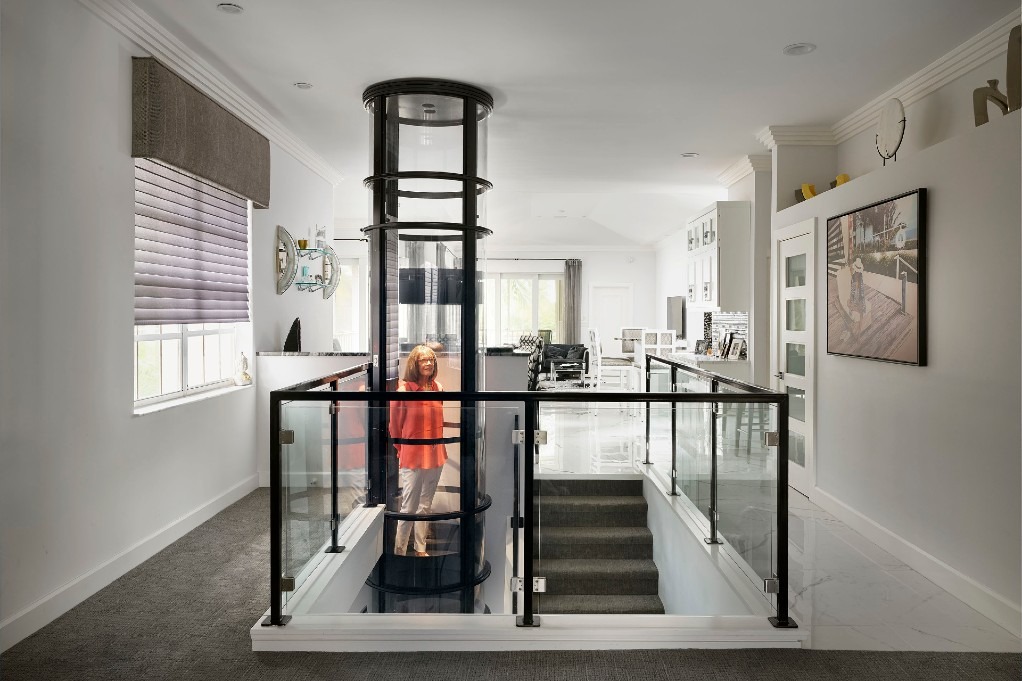
Yes. The PVE30, PVE37, and PVE52 can each be configured for up to 5 stops within 50 feet of travel, so three-floor and four-floor homes sit comfortably inside the range. The Cube, the square model in the lineup, serves up to 3 stops within 35 feet.
Pneumatic elevators are self-supporting and use air pressure rather than cables or hydraulic fluid. A pressure differential moves the car up, and controlled air release lowers it gently, all inside a transparent polycarbonate tube. Because there is no shaft to build, no pit to dig, and no machine room to house, adding a stop means cutting one more aligned opening through a floor rather than extending an enclosed shaft. That is why these systems fit into areas of dead space and why they are a practical option for retrofit projects in existing homes.
For a practical example, consider a coastal townhome with a ground-level garage, a main living floor, a second-floor bedroom suite, a third-floor guest room, and a rooftop deck. A PVE37 or PVE52 can serve all five levels in a single vertical run, giving everyone in the household access to every floor without taking the stairs.
Which Floors Should Your Home Elevator Serve?
Start with the levels you use daily, then decide which extras are worth the added cost. Four things usually settle it.
- Accessibility and aging in place. If a family member uses a wheelchair or you plan to stay in the home long term, serving the garage, main living area, and primary bedroom floor is essential. A rooftop or attic stop is a nice-to-have.
- Floor-to-floor height. Taller ceilings and split-level designs reduce how many stops fit within the available travel. Measure actual heights rather than assuming a story equals 10 feet.
- Budget. Each stop adds doors, landing equipment, a structural opening, and installation time. Weigh the cost of another stop against how often that floor is actually used.
- Resale and futureproofing. Adding service to more floors during the initial install is simpler and less expensive than modifying the elevator later. If there is any chance you will want a fourth or fifth stop down the road, plan for it now.
Where Will The Elevator Stop?
Plan the vertical path early. Most U.S. homes stack the elevator through aligned closets, place it beside a stair landing or garage entry, or run it along an exterior wall when interior space is tight. Codes require minimum landing space at each stop, adequate door width if wheelchair use is planned, and headroom above the top landing. Footprint and clearance numbers by system type are covered in our guide to residential elevator dimensions and technical specifications. Involve an architect, builder, or authorized PVE dealer early so each landing, door direction, and structural opening is set before walls go up.
Pve Home Elevator Models And Their Travel Limits
Pneumatic Vacuum Elevators is the original manufacturer of air-driven residential elevators. Four models share the same shaftless, pitless, machine-room-less design and differ in capacity, footprint, and travel.
| Model | Passengers | Capacity | Exterior Diameter | Max Stops | Max Travel |
|---|---|---|---|---|---|
| PVE30 | 1 | 350 lb (159 kg) | 30″ | 5 | 50 ft |
| PVE37 | 2 | 450 lb (205 kg) | 37″ | 5 | 50 ft |
| PVE52 | 3, or wheelchair plus attendant | 525 lb (238 kg) | 52 11/16″ | 5 | 50 ft |
| The Cube | 2 | 450 lb (205 kg) | 36″ x 36″ (square) | 3 | 35 ft |
All four models are pre-assembled and tested at PVE headquarters before shipping. Installation is typically completed in two to three days once site preparation is finished, which matters in a multi-floor retrofit where disruption is the main concern.
Do You Need A Pit Or Machine Room For A Multi-Floor Home Elevator?
Not with a pneumatic system. Hydraulic and traction elevators generally need a pit at the lowest landing, and hydraulic units usually need a separate space for the pump and fluid reservoir, both of which get more involved as floors are added. PVE elevators are self-supporting and require no pit, no shaft, and no dedicated machine room, because the turbine sits at the top of the cylinder or in a nearby split-unit configuration. Some jurisdictions still have specific requirements for equipment clearances, access panels, and electrical service, so confirm local rules early in design.
How To Decide How Many Floors Your Elevator Should Serve
- Map your home. List every level, including the basement, mezzanine, and roof deck. Note ceiling heights and mark which levels are essential for daily living or accessibility.
- Set priorities. Separate must-have stops such as the garage, main floor, and bedroom level from nice-to-have stops such as an attic or rooftop.
- Check vertical alignment. Look for stacked closets or a clear vertical path, and consider whether a shaftless system could fit without large structural changes.
- Consult local codes. A call to your city or county building department will confirm any travel limit and special requirements for your area.
- Schedule a professional consultation. An authorized PVE dealer can validate code limits, confirm the maximum travel and stops for your chosen model, and put a formal proposal in writing.

How Future-Proof Is A Multi-Floor Home Elevator?
It depends on the system. Adding or reconfiguring stops later is difficult with shafted equipment, because it means cutting through finished floors and walls, rerouting electrical, and sometimes replacing rails and controls. Modular, self-supporting systems are more adaptable, though planning ahead still saves time and money.
Planning for mobility changes may justify serving more floors from the start, even if some levels see less use today. More floors also mean more landings and doors to keep in service, so routine maintenance by a qualified elevator technician matters more as the stop count grows. A code-compliant system from a manufacturer with a dealer and service network behind it is what keeps all of those floors working over the long run.
FAQ
Can I upgrade my existing two-stop home elevator to serve more floors?
Sometimes, but it is rarely simple. It may require new equipment, additional structural openings, updated controls, and fresh permits. In many cases it is more economical to plan all desired stops during the initial install, especially with shaft-based systems where the structural work is significant.
Does adding more floors make a home elevator slower?
Travel speed stays the same. Residential elevators typically move at around 40 feet per minute regardless of how many stops they serve, so more floors simply mean a longer ride. A full 50-foot run at that speed takes a little over a minute.
Are there special code requirements for a 4-stop or 5-stop residential elevator?
The core safety requirements in ASME A17.1 Section 5.3 apply to all private residence elevators. Some jurisdictions add rules for taller installations, such as specific communication devices, emergency lighting, or inspection intervals. A licensed elevator contractor handles these during permitting.
Will a multi-floor home elevator work during a power outage?
Most residential elevators, including PVE systems, need utility power to travel up. PVE elevators use gravity-assisted descent, so the car can be lowered safely to the nearest landing without power. If you want full backup capability, discuss battery or generator options with your dealer while planning multi-floor service.
How far in advance should I plan a multi-story elevator for new construction?
Bring the manufacturer or dealer in during early design, ideally at the schematic or framing stage. That way floor openings, structural supports, electrical connections, and clearances for every intended stop are coordinated before walls and finishes go in. Waiting until framing is complete limits your options and raises costs.