Skip to content >
Philadelphia Elevators For Homes
RESIDENTIAL ELEVATORS IN PHILADELPHIA AND SURROUNDING AREAS
In 2 days you can have installed a home elevator that will make
your house more accessible, attractive and valuable.
We have many years of experience installing residential elevators all over the Philadelphia and surrounding areas.
Enjoy the benefits of a residential elevator powered by AIR!
Philadelphia Home Elevators: Easy to Install
1 – 3 Passengers / Wheelchair Accessible Model
Panoramic Design
360° Visibility
Space Saving
No Pre-Construction Pit, Hoist Way or Machine Room Required
Fast Installation
2 – 3 Day Installation
Pneumatic Technology
Powered by the Most Abundant Resource in the World… AIR!
Are you in need of a small single passenger elevator? Maybe a wider wheelchair
accessible lift?
PVE home lifts are designed to meet all homeowner needs!
Learn more about all 4
models of our residential elevators below:

Get a Free Quote!
HOME ELEVATORS – In Home Consultation
Simply resting on the existing ground floor and requiring much less space than traditional residential elevators, these innovative home elevators can be installed almost anywhere inside your home!
Contact PVE to learn more about scheduling a free in home consultation today!

PHILADELPHIA HOME ELEVATOR ADVANTAGES
Our home elevators located in the Philadelphia area, are designed to provide several benefits:
We serve all of Philadelphia and the surrounding areas!
Manufactured in the United States, PVE has years of experience designing home elevators for projects in Philadelphia, Pennsylvania! From stylish residential lifts to modern home installations, our vacuum elevators are redefining comfort and accessibility across Philadelphia and throughout the region. Learn more about where we operate on our home elevator services across Pennsylvania.
Home Elevators: Modern and Easy to Install
Forget everything you thought you knew about home elevators. Our environmentally friendly, state-of-the-art residential home elevators help you and your family members move between floors with ease. You can enjoy the luxury of a home elevator without all the hassles of traditional elevators.
Minimal Maintenance: Save Time and Money
If you are one of those people who always forget to schedule maintenance for your appliances, don’t worry! Our home elevators have very few moving parts and do not require any lubrication. Since the design of our elevators is so simple, you only need to call us for a replacement seal every four to five years or 15,000 rides.
Absolute Safety: Fully-certified Home Elevators
Pneumatic vacuum elevators are fully certified by the American Society of Mechanical Engineers and have been a tested and proven revolutionary change to the elevating industry over the course of the last ten years. If you need a safe, reliable, and attractive lift in your home without the mess and cost of a traditional home elevator, give us a call to get you in touch with your local authorized PVE® dealer.
Space Saving Solution for your Home
You don’t need a lot of room in your home for one of our home elevators. Our lifts do not require an equipment room and there is no need for a pit/well under the bottom floor or above the top floor for these elevators. For other elevators, these additional spaces are required for the heavy operating equipment, but PVE® home elevators bypass the need for anything else but space for the cylinder. This not only means a smaller footprint in your home but a much less costly and less messy construction project in comparison to a traditional home elevator.
Pack & Go: Self-Supporting Home Elevators
Even if you plan on moving in the future, you don’t have to leave your elevator system behind. PVE® manufactures completely enclosed elevators that are not built into the framework of your home. This means that the self-contained home elevators can be moved to your new home if you decide to relocate in the future. You can even change the elevator’s location inside your existing home if you remodel or add on to your home.
Three Air-Driven Home Elevator Models
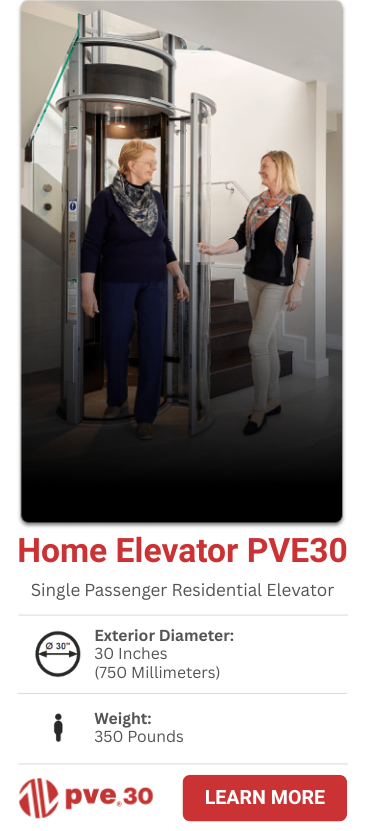
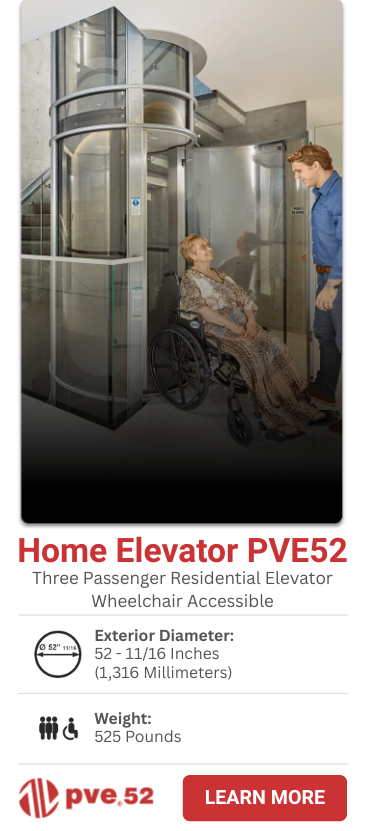
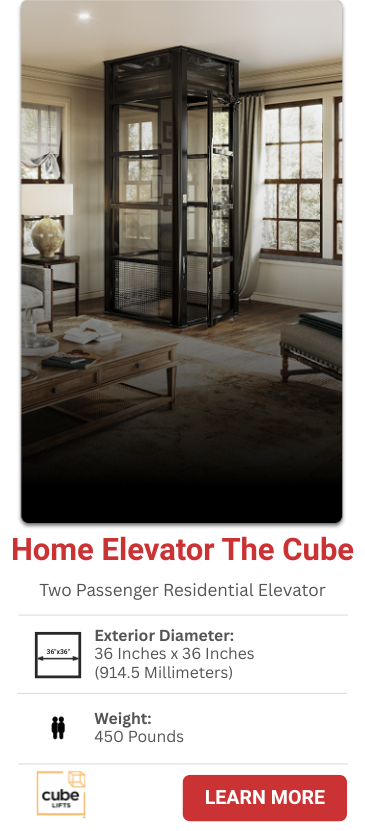
Our air driven home elevator line includes choices for one to three adults or for a person in a wheelchair with an attendant. PVE® manufactures our elevators with exterior diameters ranging from a minimal 30 inches to a spacious 52 11/16 inches. The type of elevator you choose will depend on you and your household’s space and needs. For single, standing riders, the PVE® 30 will suffice. The PVE® 37 is a good choice if you need a little more space for two adults to ride, or the option of a foldable cabin seat. And the PVE® 52 is the answer for the wheelchair accessible model or a spacious and luxurious home lift.
TESTIMONIALS
I thoroughly enjoy riding in my PVE elevator as its extremely comfortable… I would unhesitatingly, recommend it to people who are confined to a wheelchair like myself, to me it’s that good and reliable!
Tamara Gordon
My house was built in 1925 and it was hard to get something to fit in with the décor of my home, but the PVE fit in perfectly. I am thrilled with the design, engineering, and reliability of the vacuum elevator.
Stan Barth
Highly recommend. Working with PVE was such an incredible experience! From our very first meeting they were so professional, time efficient & helpful. Couldn’t be happier. Our elevator is heaven sent. Thank you PVE & team.
Kim Klotz
Residential Elevator Manufacturers
Pneumatic Vacuum Elevators LLC is the designer and manufacturer of the vacuum elevator.
PVE currently manufactures three versions of its air driven residential elevators, ranging from single to a three-passenger, wheelchair-accessible home elevator. All of PVE’s vacuum home lift systems are capable of up to a 50 foot (15m) vertical rise over as many as five stops. The unique design of the vacuum residential elevator is a perfect choice for any retrofit or new construction project and will enhance the value of one’s home without the consuming footprint of a traditional home elevator. The innovative home elevator does not require any pre-construction shaft, pit or machine room and can be installed in as little as two to three days. By using a vacuum pump to generate areas of higher and lower atmospheric pressure within the cylinder hoist way, the unit smoothly moves between floors while using much less energy than other home elevators.
Contact Us
Pneumatic Vacuum Elevators
Worldwide Headquarters
Address: 4151 West 108th Street Suite # 1 Hialeah, FL 33018
Phone: (305) 884-1091
Email: support@vacuumelevators.com
Hours: Monday – Friday | 08:00AM EST – 05:00PM EST