Skip to content >

- Quick Answer
- Why This Decision Matters More Than Most Home Upgrades
- How Pneumatic (Vacuum) Elevators Work
- How Hydraulic Home Elevators Work
- Side-by-Side Comparison
- Installation and Space Requirements
- Cost Comparison
- Capacity and Performance
- Maintenance and Long-Term Ownership
- Safety
- Aesthetics and Design
- Pneumatic Elevator Pros and Cons
- Hydraulic Elevator Pros and Cons
- Which Is Right for Your Home?
- Why Homeowners Choose PVE
Quick Answer
Pneumatic elevators use air pressure to move a cab through a sealed cylindrical shaft. Hydraulic elevators use a fluid-driven piston. The practical difference: pneumatic systems need no pit and no machine room, install in 2 to 3 days, and carry 1 to 3 passengers. Hydraulic systems require a pit and a machine room, install in 4 to 8 weeks, and carry 750 to 1,000+ pounds. Pneumatic is the better fit for retrofits, slab-foundation homes, and limited space. Hydraulic is the better fit for larger custom homes, higher capacity needs, and traditional cab aesthetics.
Why This Decision Matters More Than Most Home Upgrades
Choosing between a pneumatic (vacuum) elevator and a hydraulic elevator is one of the first real decisions homeowners face when planning a residential lift. Both systems safely and reliably move people between floors, but they work in fundamentally different ways. The right choice depends on your home’s construction, home layout, how much space you can dedicate to the elevator, how many people need to ride at once, and what you want the finished installation to look and feel like.
This guide walks through how each system works, how they compare on the factors that actually change your buying decision, and how to tell which home elevator system fits your home.
How Pneumatic (Vacuum) Elevators Work
A pneumatic vacuum elevator moves the cab through a sealed cylindrical shaft using air pressure alone. A vacuum pump at the top of the shaft reduces the air pressure above the cab, and the higher pressure below pushes the cab upward. To descend, the pump gradually releases air back into the upper chamber, and the cab settles down under controlled gravity.
There are no cables, pistons, counterweights, hydraulic fluid, or machine room. The entire drive system sits at the top of the elevator itself. That single design decision drives most of the practical differences between pneumatic and hydraulic systems. Space, installation, maintenance, energy efficiency, and safety all flow from it.
For residential use, PVE builds three home elevator configurations: the PVE30 for one passenger, the PVE37 for two, and the PVE52 for two to three passengers or a wheelchair user with a companion. The Cube rounds out the lineup for homes where a rectangular footprint fits better than a cylindrical one.
How Hydraulic Home Elevators Work
A hydraulic home elevator uses a fluid-driven piston to raise and lower the cab. An electric pump forces pressurized hydraulic fluid into a cylinder, which extends a piston beneath the cab and pushes it upward. To descend, valves release fluid back into a reservoir, and the cab lowers under its own weight. That fluid-driven mechanism is what gives hydraulic systems their higher load capacity.
Hydraulic systems have been the traditional choice for residential elevators for decades. They come in three main variants: holed (piston set into a drilled pit), holeless (piston mounted alongside the cab), and roped hydraulic (piston plus a pulley system). Each variant has slightly different space and cost profiles, but all hydraulic systems share the same core requirement. They need a dedicated machine room to house the pump, reservoir, and control equipment, and for most configurations, a pit dug beneath the lowest floor.
Side-by-Side Comparison
| Factor | Pneumatic (Vacuum) | Hydraulic |
|---|---|---|
| Elevator system | Air pressure differential | Fluid-driven piston |
| Pit required | No | Usually yes |
| Machine room required | No | Yes |
| Typical passenger capacity | 1 to 3 | 2 to 5+ |
| Lifting capacity | Up to 525 lbs [verify against PVE52 spec] | 750 to 1,000+ lbs |
| Travel height | Up to ~50 ft | 50+ ft |
| Installation time | 2 to 3 days [verify] | 4 to 8 weeks [verify] |
| Structural modifications | Minimal | Significant (pit and machine room) |
| Maintenance profile | Minimal, no fluids, few moving parts | Regular fluid checks, pump service |
| Energy use during descent | None (gravity plus controlled air release) | Pump active in some configurations |
| Aesthetic | Cylindrical, glass, panoramic | Enclosed cab, customizable panels |
| Best fit | Retrofits, slab foundations, tight footprints, 1 to 3 passengers | Larger custom homes, higher capacity needs, traditional aesthetics |
The biggest key factors here are space, capacity, and installation complexity.
Installation and Space Requirements
The starkest difference between pneumatic and hydraulic systems shows up on installation day.
A pneumatic vacuum elevator is self-contained. The entire drive assembly lives at the top of the shaft, so no pit, no machine room, and no counterweight system is required. That makes it a space-saving solution for homes with limited floor space. Installation typically finishes in 2 to 3 days with minimal structural disruption. That makes pneumatic systems particularly practical for existing homes, especially those built on slab foundations without a basement, where excavating a pit isn’t feasible without major cost.
A hydraulic elevator requires more of your home. You lose a closet, a corner of a garage, or a small utility room to the machine room, and most configurations require a pit dug beneath the lowest floor to accommodate the piston and cab base. Installation typically runs 4 to 8 weeks and involves excavation, structural framing, hydraulic plumbing, and machine room build-out. In a new construction project, that timeline can fit inside the broader build. In a retrofit, it often means significant renovation.
The trade-off works both ways. Pneumatic systems give you back the space that would otherwise go to elevator equipment, but the cylindrical tube itself is more visible in your home than a paneled hydraulic cab. You’re trading equipment space for a design statement.
Cost Comparison
Both systems fall into a similar overall cost range, but the breakdown differs.
Pneumatic vacuum elevators typically run $35,000 to $100,000+ with pricing driven mainly by model (PVE30, PVE37, or PVE52), number of stops, and finish options. Because installation is fast and requires no structural excavation, most of the total cost is the elevator itself.
Hydraulic elevators typically run $30,000 to $70,000+, with a wider range because the type matters. Holeless hydraulic systems sit at the lower end. Roped and traditional holed systems, especially with custom cab finishes, climb toward the top of the range. Beyond the elevator itself, hydraulic installations carry construction costs (pit excavation, machine room build-out, electrical, and finish work) that pneumatic systems don’t.
Capacity and Performance
Hydraulic elevators have the edge on raw lifting capacity. A residential hydraulic system can typically carry 750 to over 1,000 pounds and accommodate 4 to 5 passengers or larger loads. That’s useful if you’ll routinely move furniture between floors, need to transport multiple people at once, or want a fully custom cab larger than pneumatic dimensions allow.
Pneumatic vacuum elevators are engineered for residential use with 1 to 3 passengers. The PVE30 carries one person, the PVE37 carries two, and the PVE52 carries two to three passengers or a wheelchair user with a standing companion. In practice, pneumatic systems are built for lighter residential trips, not heavy loads. For the vast majority of home use cases (daily travel between floors, aging-in-place accessibility, mobility assistance, moving groceries or laundry) this capacity is more than sufficient.
Travel height and speed are comparable at residential scale. Both systems handle typical two- to five-story homes without difficulty. Hydraulic systems can travel higher (50+ feet) and slightly faster, but neither factor typically drives the decision on the best elevator for the household’s real use case.
Maintenance and Long-Term Ownership
Pneumatic systems have fewer parts that can fail. There’s no hydraulic fluid to check, top off, or replace. No pump seals to degrade. No piston to service. Routine maintenance is limited to annual inspections of the vacuum turbine, seals, and control system.
Hydraulic systems require ongoing fluid management. Hydraulic fluid needs to be monitored, topped off, and eventually replaced. The pump and seals require periodic service. Fluid leaks, while uncommon in well-maintained systems, carry both operational and environmental consequences that pneumatic systems don’t have.
Over a 20-year ownership horizon, pneumatic systems typically require less service time and lower maintenance spend. Hydraulic systems are highly reliable when serviced properly, but the service demand is real.
Safety
Both systems are engineered to strict safety standards and include emergency features required by code. The mechanics of what happens in a fault condition differ significantly.
A pneumatic vacuum elevator descends by controlled release of air pressure. If power is lost mid-ride, the system uses the pressure differential itself to lower the cab safely to the nearest floor. Gravity and the remaining vacuum handle the descent without needing electricity. There are no cables that can snap, no counterweights, and no piston that can fail catastrophically. PVE elevators are built to A17.7 code compliance for residential vacuum elevators.
A hydraulic elevator’s primary safety consideration is the hydraulic system itself. Modern hydraulic elevators include multiple safeguards: safety valves that prevent free-fall in the event of a pipe rupture, backup lowering systems, and emergency communication. Hydraulic fluid leaks are the main failure mode and require regular inspection to prevent both operational issues and potential environmental contamination.
Both systems, properly installed and maintained, are safe for daily residential use.
Aesthetics and Design
The two systems look completely different in a home, and this often matters more to homeowners than they initially expect.
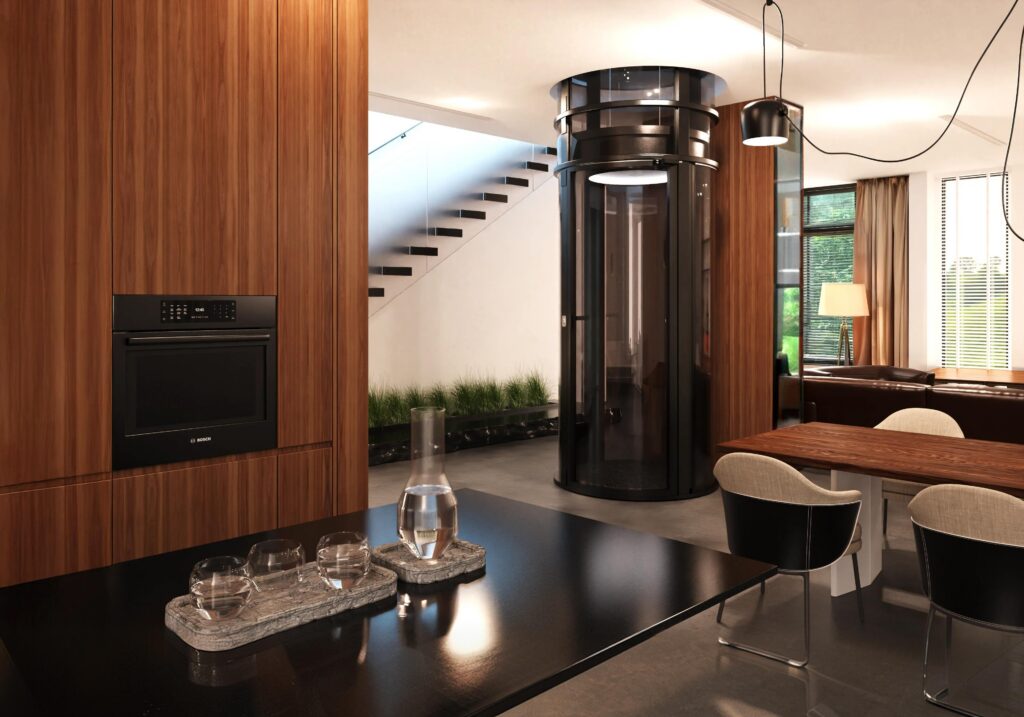
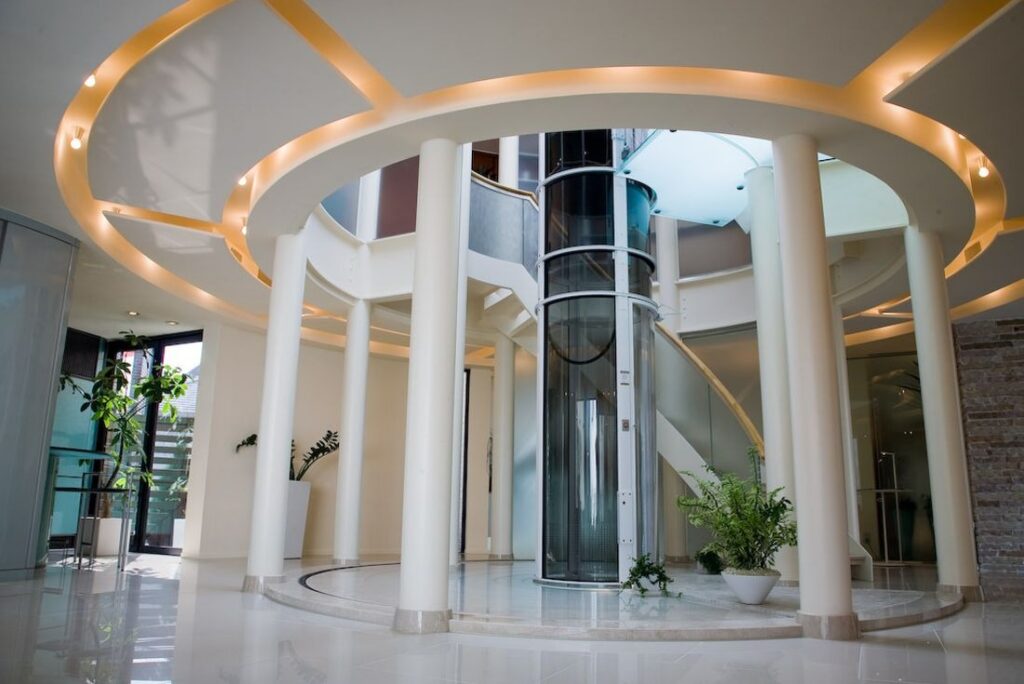
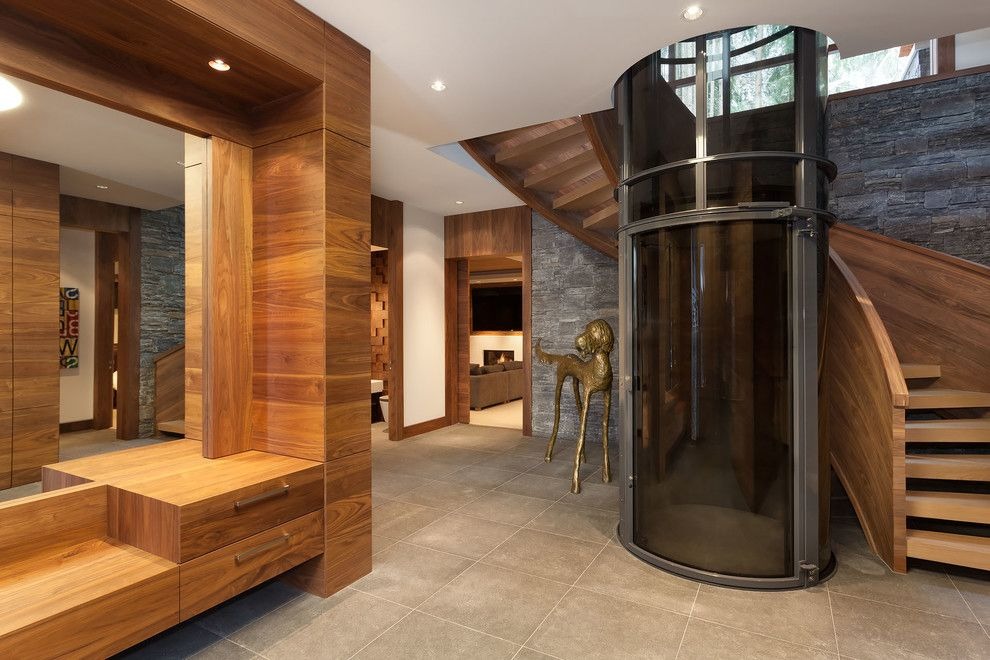
A pneumatic vacuum elevator is a cylindrical glass tube with 360-degree visibility. Its modern design becomes an architectural feature, a transparent focal point that suits contemporary interiors, open floor plans, and homes where the elevator is meant to be seen. Natural light passes through it. It doesn’t visually close off the space around it.
A hydraulic elevator uses a traditional rectangular cab (or elevator car) with solid walls that can be finished in wood, metal, glass, or custom panels to match your home’s style. That customization flexibility makes hydraulic systems the better fit for traditional or transitional home designs where a glass tube would feel out of place. The trade-off is a larger visual footprint and less transparency.
Neither aesthetic is objectively better. The right choice depends on your home’s architecture and how you want the elevator to feel inside it.
Pneumatic Elevator Pros and Cons
Pros
- No pit or machine room required
- Installation typically completed in 2 to 3 days
- Minimal structural modifications
- Lower maintenance costs, no fluids, fewer moving parts
- Uses less energy than hydraulic systems, with no power consumption during descent
- Modern glass-tube aesthetic with panoramic visibility
- Well-suited to slab-on-grade homes and retrofits
- Passive safe-descent design in power loss conditions
Cons
- Lower weight and passenger capacity than hydraulic (typically 1 to 3 riders)
- Cylindrical design may not suit traditional home aesthetics
- Travel height ceiling lower than hydraulic
- Not ADA-compliant (residential application only)
Hydraulic Elevator Pros and Cons
Pros
- Higher weight and passenger capacity (750 to 1,000+ lbs)
- Larger cab size accommodates furniture, wheelchairs with attendants, or multiple passengers
- Fully customizable cab finishes for traditional or custom home aesthetics
- Higher travel height ceiling
- Long service life with proper maintenance
Cons
- Requires a machine room and (usually) a pit, meaning significant structural work
- Installation typically 4 to 8 weeks
- Ongoing hydraulic fluid maintenance and monitoring
- Higher energy consumption; some residential comparisons estimate hydraulic systems use more than three times the energy of pneumatic systems [verify source]
- Potential environmental and operational risk from fluid leaks
- Larger visual footprint inside the home
- Higher installation labor and construction costs
Which Is Right for Your Home?
A pneumatic vacuum elevator is usually the better fit when:
- Your home sits on a slab foundation with no basement
- You’re retrofitting an existing home and want minimal renovation
- Space is limited and you can’t dedicate a machine room
- Daily use is 1 to 3 passengers
- You want a fast installation with minimal disruption
- The modern glass-tube aesthetic suits your home’s design
- You want lower long-term maintenance and a smaller environmental impact
A hydraulic elevator is usually the better fit when:
- You’re building a new custom home with capacity to plan a pit and machine room
- You need to carry heavier loads or more than three passengers
- You want a fully customized cab to match a traditional interior
- You need travel height above pneumatic capacity for multiple floors
- You’re comfortable with ongoing fluid maintenance in exchange for higher capacity
For homeowners who fit neither profile cleanly (for example, a mid-size retrofit where either could work) the best elevator type usually comes down to home layout, capacity needs, and renovation tolerance. If you can’t excavate a pit without major cost, pneumatic wins by default.
Why Homeowners Choose PVE
For homes where the pneumatic profile fits, PVE pioneered this elevator type and has spent two decades refining it. Every PVE elevator is built to A17.7 residential code, installs in days rather than weeks, and comes in three sizes engineered around the way people actually use elevators at home: one person, two people, or a wheelchair user with a companion.
Explore the main options that fit your home: