Skip to content >

- What "Choosing a Home Elevator" Really Means
- Key Takeaways
- What Does Choosing a Home Elevator Actually Involve?
- Which Home Elevator Fits Your Home? Quick Decision Snapshot
- How Much Space Does a Home Elevator Need?
- Who Will Ride the Elevator, Now and Later?
- How Much Construction Will Your Home Need?
- Which Drive System Is Right for Your Home?
- What Does Long-Term Maintenance Look Like?
- What Safety Features Should You Look For?
- How Do You Match the Elevator to Your Home's Style?
- How Much Does a Home Elevator Cost?
- Which PVE Model Should You Choose?
- Frequently Asked Questions (FAQs)
- Next Steps: Talk to an Authorized PVE Dealer
What “Choosing a Home Elevator” Really Means
To choose a home elevator, work through three questions in order: how much space you have, who will ride the elevator now and in the next five to ten years, and how much construction your home can absorb. Match those answers to a drive system (pneumatic vacuum, hydraulic, traction/cable, or shaftless), then pick the specific model that fits your floor plan, number of stops, and mobility needs. For most existing homes with limited space, self-supporting pneumatic vacuum elevators offer the shortest install and the least structural disruption.
Key Takeaways
- Available space and your home’s structure narrow your options faster than any other factor, especially in an existing home.
- Pneumatic vacuum elevators need no pit, no traditional elevator shaft, and no separate machine room, which makes them a strong fit for retrofits.
- Match cab capacity and door width to the mobility aids you may need in five to ten years, not just today.
- Long-term maintenance patterns differ by drive system: hydraulic and traction typically need annual service; pneumatic vacuum service runs every four to five years or roughly 15,000 rides.
- PVE offers four models: PVE30 (single passenger), PVE37 (two passenger), PVE52 (wheelchair accessible), and the Cube (larger square cab).
What Does Choosing a Home Elevator Actually Involve?
Choosing a home elevator is a set of trade-offs across space, users, construction, safety, design, and long-term value. Most guides list elevator types without helping you decide which one actually belongs in your house. This guide takes the opposite approach and walks through the decisions in the order they actually matter, then points you to the right type of elevator at the end.
Home elevators are built to move people safely between floors as a long-term feature of the home. Stair lifts and platform lifts solve narrower mobility problems; residential elevator installations are designed to serve multi story homes for decades. This guide focuses on two- to four-story homes, whether you are planning new construction or adding a lift to an existing home.
Common reasons homeowners start this process include aging in place, helping a spouse or parent avoid daily stairs, improving accessibility after surgery, moving groceries and laundry between floors, and adding a design feature to a multi-level property. By the end, you will know how to match a type of elevator to your home’s layout, users, and long term plans.
Which Home Elevator Fits Your Home? Quick Decision Snapshot
Use this table as a starting point, not a final answer. Confirm feasibility with a local, authorized dealer once you have measured your available space.
| Scenario | Options to Consider | Strengths | What to Check |
| Existing two-story home, limited space | Pneumatic vacuum elevator (PVE30 or PVE37) or shaftless home elevators | No pit, no machine room, small footprint | Ceiling height, floor load capacity |
| Three-story new construction, generous floor plan | Hydraulic elevators or traction/cable systems | High weight capacity, smooth ride, wide finish options | Pit depth, elevator shaft framing, separate machine room location |
| Rider uses a wheelchair or mobility aid | Wheelchair-accessible residential elevator such as PVE52 or Cube, or a larger traditional cab | Wheelchair-accessible cab space, level entry | Door width, cab dimensions, turning space, weight capacity |
| Design-focused luxury home | Glass panels with a panoramic vacuum elevator or glass elevator cab | Aesthetic integration, natural light | Structural support, home’s style continuity, budget |
| Budget-conscious retrofit, minimal disruption | Shaftless elevators or compact pneumatic elevators | Reduces major structural changes vs. traditional shafted systems | Local building codes, electrical components, available space |
Your home’s specific conditions, joist layout, plumbing runs, and ceiling heights always have the last word.
How Much Space Does a Home Elevator Need?
Space requirements vary by type of elevator, cab style, number of stops, and local code compliance. Traditional shafted elevators need room for a hoistway, cab clearance, guide rails, and often a pit or machine room, which is why they can be difficult to retrofit into a tight floor plan. Pneumatic elevators use a compact circular footprint and the exact vertical space depends on the model.
For a full breakdown of clearances, cab dimensions, and hoistway specs by system, see our guide to residential elevator dimensions before you commit to a location.
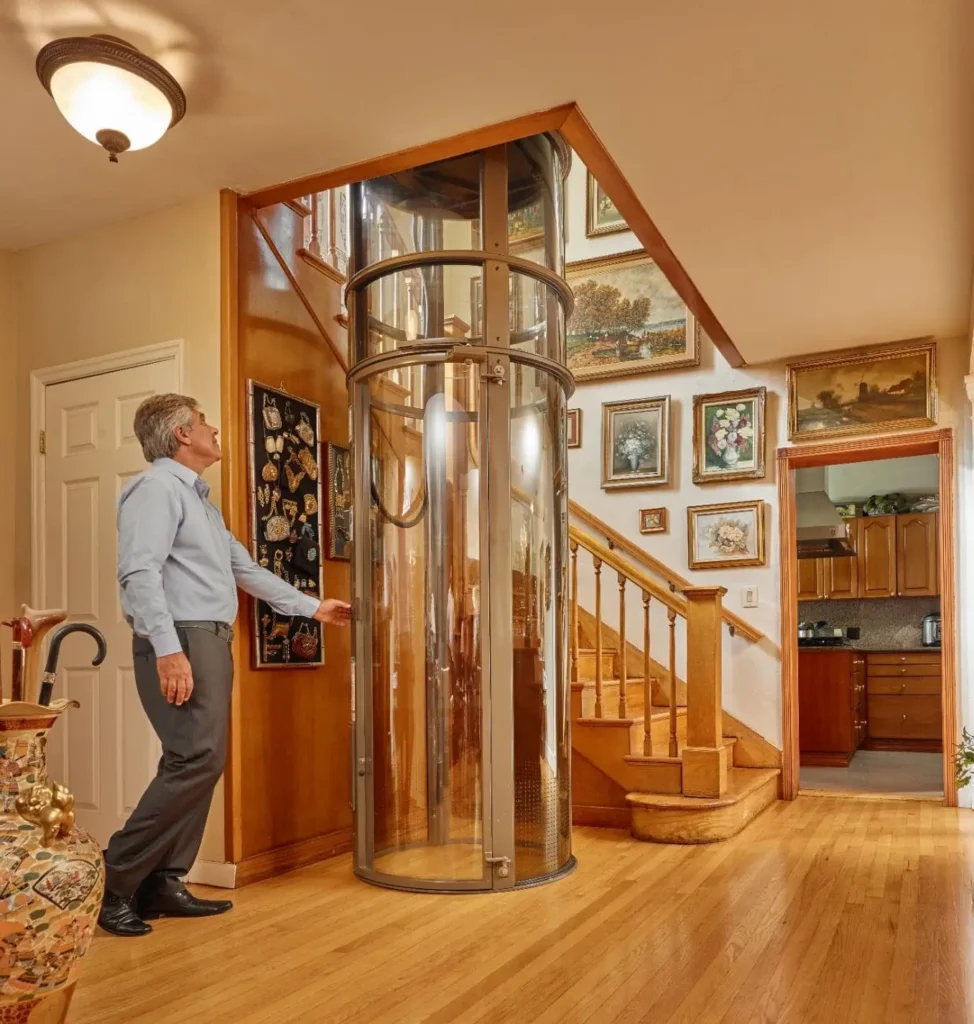
Because PVE elevators are self-supporting, they do not need a traditional hoistway, pit, or machine room, which opens up placements that a conventional lift would rule out.
Common placement locations include:
- Beside or through an existing stairwell
- Inside stacked closets aligned vertically across floors
- A corner of the living room or hallway
- A garage-to-main-floor configuration for single-level entry
In new construction, framing an elevator shaft, pouring a pit, and routing utilities is straightforward. In an existing home, you have to work around joists, plumbing, HVAC, and load-bearing walls, so a site visit from a qualified installer becomes essential.
Measurement checklist to prepare before a consultation:
- Clear floor area on each level (length × width or diameter available)
- Floor-to-floor and floor-to-ceiling heights at every stop
- Location of joists, beams, and load-bearing walls
- Existing plumbing, HVAC, and electrical runs in the path
- Access for equipment delivery (doorway widths, hallway clearances)
Who Will Ride the Elevator, Now and Later?
Choosing a home elevator is partly an independence and healthcare decision, not only a design or construction choice. The right elevator depends on who rides it today and who may need it five to ten years from now.
Consider these scenarios:
- A healthy couple in their mid-fifties planning for long term accessibility as they age
- A single resident who currently uses a walker and needs a level, flush entry
- A household with a family member in a power wheelchair requiring through-car access and adequate turning radius
- Grandparents hosting visiting grandchildren who may ride along
Weight capacity varies by elevator type and model. Some compact elevators are designed for one standing passenger, while larger residential elevators may accommodate multiple riders, wheelchairs, or mobility aids. Always confirm passenger capacity, wheelchair compatibility, and weight limits with the manufacturer or authorized dealer.
For a deeper look at accessibility features and how a home elevator supports independence as mobility changes, see our guide to home elevators for seniors.
For PVE, this is where model selection matters. The PVE30 fits a single standing passenger, the PVE37 makes room for two, the PVE52 is wheelchair accessible, and the Cube offers a larger square cab for riders who want more room.
Key accessibility factors to evaluate:
- Door width (minimum 32–36 inches for wheelchair users)
- Cab space and interior turning radius
- Handrail placement and control button height (reachable from a seated position)
- Level threshold entry vs. ramped entry
- Passenger count: one, two, or three riders
Even if your mobility is excellent now, planning ahead prevents costly retrofits later. Spec the elevator for the mobility aids you may eventually need, not only the ones you use today.

How Much Construction Will Your Home Need?
This is where the gap between elevator types becomes most visible. Traditional systems require significant structural work. Shaftless designs require far less.
Traditional hydraulic or traction home elevators typically need:
- A pit at the base of the hoistway (often 6–12 inches of pit depth, sometimes more)
- A framed elevator shaft with fire-rated walls in many jurisdictions
- Overhead clearance of several feet above the top landing
- A separate machine room or dedicated equipment closet for the motor, pump, or counterweight system
Counterweighted elevators often need a dedicated machine room, which adds square footage and cost. Between the hoistway, pit, overhead clearance, and equipment space, traditional systems usually require a significant permitting process and construction schedule before installation can even begin.
Shaftless, air-driven elevators like PVE flip this equation. Pneumatic elevators require no machine room, and the self-supporting cylinder sits on the finished floor with only localized cut-outs at upper landings. Once the site is ready, PVE elevators can typically be installed in as little as two to three days, depending on model, number of stops, and local requirements.
Before you commit, check local building codes, the permitting process, and inspection schedules in your jurisdiction. In new construction, coordinate with your architect or general contractor during framing so openings, electrical components, and any pit work are planned from day one.
Which Drive System Is Right for Your Home?
This is a decision-focused comparison. For a full breakdown of each system’s engineering, see our guide to the types of home elevators.
Hydraulic elevators use fluid-filled rams driven by an electric motor and pump. They are quiet under load, offer strong weight capacity, and deliver a smooth ride. The trade-offs are a required machine room, periodic fluid maintenance, and pit depth. Hydraulic systems fit new builds with room for the equipment.
Traction elevators use steel ropes over a sheave, usually with a counterweight. They are efficient, smooth, and capable of higher speeds. Machine-room-less (MRL) versions cut overhead space but still need a constructed shaft and pit.
Winding drum elevators use a drum to wind cables and can serve up to six stops in some models. They work in tall homes but share the shaft and pit requirements of other cable systems.
Shaftless elevators serve limited space between two floors and remove the traditional hoistway, which makes them retrofit-friendly for two-story homes.
Glass elevators are chosen for visual appeal. Glass panels let natural light through, open up the space visually, and can act as a design feature.
Pneumatic vacuum elevators, like PVE, use air pressure to lift the cab and gravity plus controlled airflow to lower it. They use no cables, pulleys, or hydraulic fluid. Because the structure is self-supporting, PVE elevators need no traditional hoistway, pit, or machine room. For the physics behind the drive system, see our explainer on how a pneumatic elevator works.
When comparing, weigh the drive system against your available space, construction tolerance, capacity needs, and design goals. The right elevator is the one that fits all four.
What Does Long-Term Maintenance Look Like?
Home elevator cost extends well beyond the purchase price. Every residential elevator needs long term maintenance, and the differences in ongoing expense are significant.
Typical maintenance patterns:
| System | Service Interval | Key Service Items |
| Hydraulic | Annually or semi-annually | Fluid levels, seals, pump, valves |
| Traction / Cable | Annually | Ropes, brakes, motor, controller |
| Pneumatic Vacuum (PVE) | Every 4–5 years or ~15,000 rides | Vacuum pump, seals, sensors, door interlocks |
Hydraulic elevators pull more power during lifting and rely on fluid that can wear or leak over time. Traction elevators use counterweights that improve efficiency, and some systems recover energy on descent. Vacuum elevators use electricity mainly to lift the cab; the ride down uses gravity and controlled airflow, which supports energy efficiency when the elevator sits idle.
Parts availability, local service technicians, and warranty terms all shape total cost of ownership. For a detailed schedule of what routine maintenance actually looks like, see our residential elevator maintenance guide. PVE is supported by a global network of authorized dealers who handle installation, service, and long term support.
Since 2002, Pneumatic Vacuum Elevators has designed and manufactured patented vacuum elevator technology using simple physics. Quality materials and fewer moving parts than traditional elevator components support minimal ongoing maintenance.
What Safety Features Should You Look For?
Safety features are non-negotiable, especially in homes with children, pets, or residents with cognitive challenges. Every home elevator installed in a private residence should meet recognized standards.
Residential elevators should be installed per ASME A17.1 / CSA B44 and the local building codes adopted in your jurisdiction. Code compliance covers the door-gap rule, which limits the space between cab and landing doors to prevent entrapment, along with door interlocks and continued safety inspections.
Features every home elevator should include:
- Door interlocks that prevent operation unless doors are secure
- Sliding doors or automatic doors sized to code, with a safe door-gap distance
- Emergency stop or alarm features
- In-cab communication such as a phone or intercom where required
- Controlled descent or emergency lowering during a power outage
- Obstruction detection or protective door and gate systems
- Handrails and accessible controls
Questions to ask during consultations:
- Which edition of ASME A17.1 / CSA B44 is this model certified under?
- What happens during a power outage with this specific type of elevator?
- How often are safety features tested, and by whom?
- Is the installer an authorized dealer with factory training?
- How do you choose elevator gates that meet code for this cab and landing configuration?
PVE elevators include built-in safety features such as mechanical brakes and a controlled descent on power loss. An authorized dealer can confirm applicable certifications and code requirements for your location. The transparent cylinder also gives riders full visibility, which reduces the enclosed-space anxiety some people feel in traditional cabs.
How Do You Match the Elevator to Your Home’s Style?
A home elevator can either disappear into the decor or act as a design centerpiece. Your preference shapes the cab style, finish, and placement.
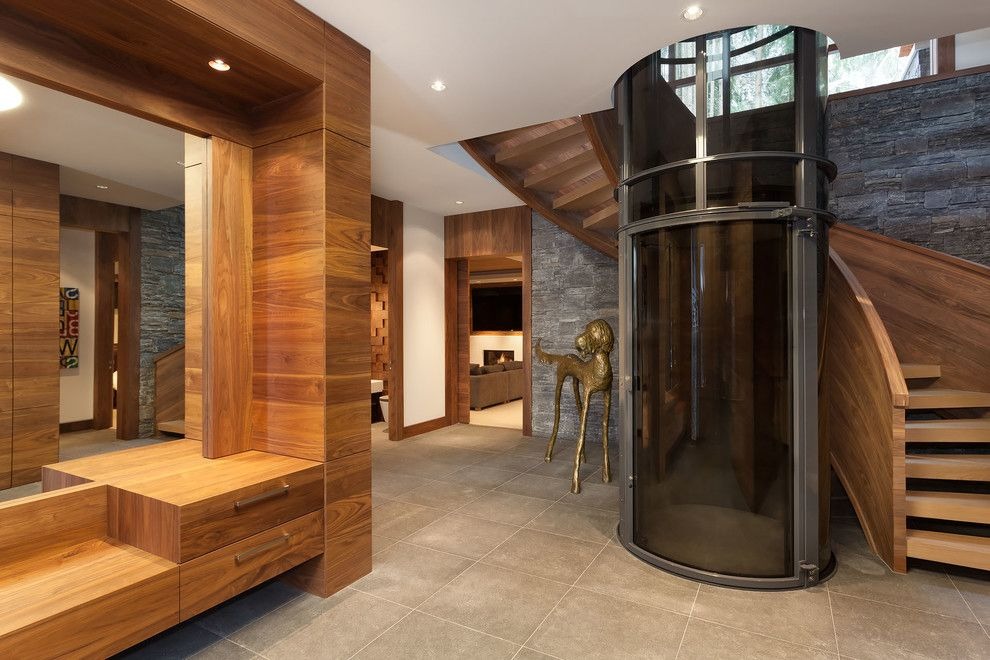
Custom finishes include wood, glass, and stainless steel. Traditional residential elevators offer enclosed cabs with wood, metal, or glass panels. Pneumatic vacuum elevators take a different approach with a clear cylindrical cab that keeps the system visible and light-filled. Elevator gates can be specified as accordion or scissor styles to fit the surrounding architecture.
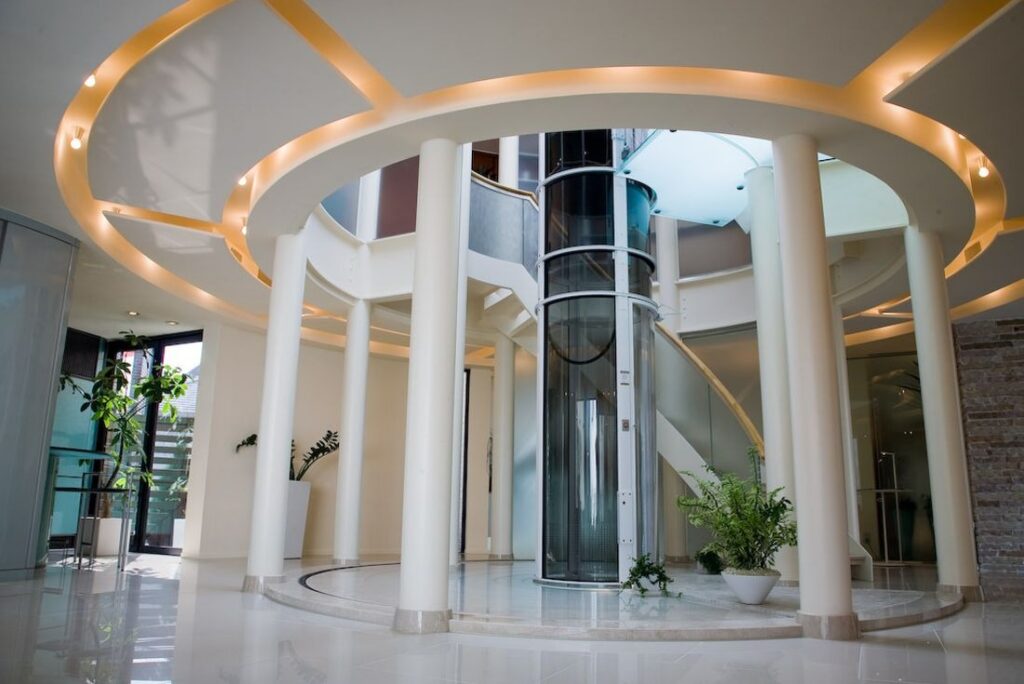
Panoramic and glass elevator cabs open up small spaces visually, especially in tight stairwells or interior corners where a solid shaft would block light. PVE’s clear cylindrical cab acts as an architectural feature rather than a hidden mechanical system. The compact, self-supporting footprint fits into places where a framed shaft would feel bulky and helps the elevator work with the home’s style rather than competing with existing finishes.
How Much Does a Home Elevator Cost?
Published cost guides place most residential elevator projects between $30,000 and $100,000+, depending on drive system, number of stops, cab size and finish, permits, and site conditions. Compact and shaftless systems can start below that range; traditional elevators, glass elevator cabs, multiple stops, and complex retrofits push the total higher. For a full pricing breakdown by system, see our home elevator cost guide.
Because every home is different, the most accurate way to budget is a site-specific quote from an authorized dealer. The quote should account for the elevator model, number of stops, floor openings, electrical components, permits, finish selections, and any construction needed before installation.
What drives the budget:
- Number of stops and total travel distance
- Major structural changes (pit excavation, elevator shaft framing, machine room)
- Cab size and finish level
- Complexity of electrical components and wiring upgrades
- Permit and inspection fees (often several hundred to $1,500+)
- Professional installation labor
Self-supporting pneumatic vacuum elevators can reduce construction scope in an existing home. They need no traditional shaft, pit, or machine room, which can offset a higher equipment price with lower structural cost. A well-integrated home elevator may also improve buyer appeal in multi story homes where accessibility and convenience matter, though it should be viewed first as a long term value investment rather than a guaranteed resale return.

Which PVE Model Should You Choose?
When you have narrowed the decision to a pneumatic vacuum elevator, the next step is picking the right model for your space, number of stops, and accessibility needs. PVE offers four models.
PVE30 – A single-passenger model that fits into remarkably small spaces. Designed for one standing rider with a capacity around 350 lbs. Often the right fit for an existing two- or three-story home where a traditional shafted elevator will not work.
PVE37 – A two-passenger model roughly 37 inches in outside diameter. Accommodates one seated user with a walker or light mobility aid, capacity around 450 lbs. Comfortable for two to four stops and homeowners who want room for a companion or cargo.
PVE52 – The wheelchair-accessible model at about 52 inches in outside diameter. Fits most standard wheelchairs plus a standing companion, capacity up to roughly 525 lbs. The right solution for accessibility-focused homes where through-car entry and generous cab space matter.
Cube – A larger square-cab model that expands the design and capacity options beyond the cylindrical footprint. Confirm current cab dimensions, weight capacity, and configuration with an authorized dealer for your project.
Shared advantages across all four PVE models:
- Self-supporting structure
- No traditional hoistway, pit, or machine room
- Compact footprint
- Panoramic 360-degree visibility
- Eco-friendly operation
- Minimal ongoing maintenance
- Installation in as little as two to three days once the site is ready
- Support through PVE’s authorized dealer network
Review model specifications, ask your dealer for local installation examples, and confirm which model best fits your home before making a final decision.
Frequently Asked Questions (FAQs)
How much space do I really need for a home elevator in an existing house?
Traditional shafted elevators need more space because they require a hoistway, cab clearance, and often a pit or machine room. Pneumatic elevators use a compact circular footprint that varies by PVE model. Measure clear floor area on each level, ceiling heights, and any nearby doors, stairs, plumbing, or electrical runs before you commit to a location.
Can I add a home elevator without moving out or doing major demolition?
It depends on the type of elevator. Building a full hoistway and pit requires heavier construction, including structural adjustments to floors, walls, and sometimes the foundation. Shaftless elevators and vacuum elevators typically need only floor cut-outs and localized framing, so most homeowners stay in place during the installation process.
How many floors can a home elevator serve?
Most residential elevators serve two to four stops. Winding drum elevators and some hydraulic configurations reach up to six levels. Vacuum elevators like PVE commonly serve three to four stops in multi story homes, with a maximum travel distance of about 50 feet. Confirm total travel and number of stops with the manufacturer for the specific model.
What happens during a power outage with different types of home elevators?
Most home elevators include emergency features such as battery-powered lowering, emergency lighting, and manual rescue procedures. Vacuum elevators like PVE use gravity and controlled airflow to lower the cab to the lowest level during power loss, allowing passengers to exit safely without electrical assistance.
Are home elevators safe for children and pets?
Home elevators safe for family use include door interlocks, obstruction sensors, controlled descent on power loss, and code-compliant door gaps. Ask the installer to walk you through the specific safety features on the model you are considering, and follow manufacturer guidance on child locks and rider supervision.
When should I involve an architect, contractor, or dealer?
For new construction, involve the elevator manufacturer or dealer during early design so shaft openings, electrical provisions, and any pit work are planned from day one. For an existing home, contact an authorized dealer first to assess feasible locations, then loop in a contractor once a concept and type of elevator have been selected.
Is a home elevator worth the investment?
It depends on your long term plans and household needs. A home elevator can support aging in place, expand accessibility, and add appeal in multi story homes. The best return is usually measured in daily quality of life rather than resale price, though a well-integrated elevator can strengthen buyer appeal in the right market.
Next Steps: Talk to an Authorized PVE Dealer
The next step is a site-specific consultation that matches your space, accessibility needs, budget, and design goals to the right solution. An authorized Pneumatic Vacuum Elevators dealer can assess your home, provide a cost range, and help you compare PVE30, PVE37, PVE52, and Cube options based on your layout and long term mobility needs.
Contact PVE to schedule a consultation or find an authorized dealer near you.