Skip to content >

- What Is a Wheelchair Accessible Home Elevator?
- Wheelchair Lift vs. Wheelchair Accessible Home Elevator
- Types of Residential Wheelchair Lifts
- What Makes a Home Elevator Wheelchair Accessible?
- Which PVE Models Are Wheelchair Accessible?
- Safety, Comfort, and Maintenance Considerations
- Is a Wheelchair Accessible Home Elevator Right for Aging in Place?
- Final Thoughts on Wheelchair Accessible Home Elevators
- Frequently Asked Questions About Wheelchair Accessible Home Elevators
A wheelchair accessible home elevator helps wheelchair users move between floors without transferring out of their chair. For homeowners planning around aging in place, mobility changes, or multigenerational living, the right elevator can help keep bedrooms, bathrooms, laundry areas, and main living spaces accessible.
PVE offers two wheelchair-accessible pneumatic vacuum elevators: the PVE52 and the Cube. Both are designed for passenger use, provide space for many wheelchair users, and can accommodate an attendant depending on the user’s mobility needs, wheelchair size, and home layout. The PVE52 uses a cylindrical cab; the Cube uses a larger square cab that expands interior space and design options.
Unlike many traditional home elevators, both the PVE52 and Cube are self-supporting and require no traditional shaft, pit, or machine room. That design can make either model a practical option for existing homes where space, accessibility, and construction disruption are important concerns.
What Is a Wheelchair Accessible Home Elevator?
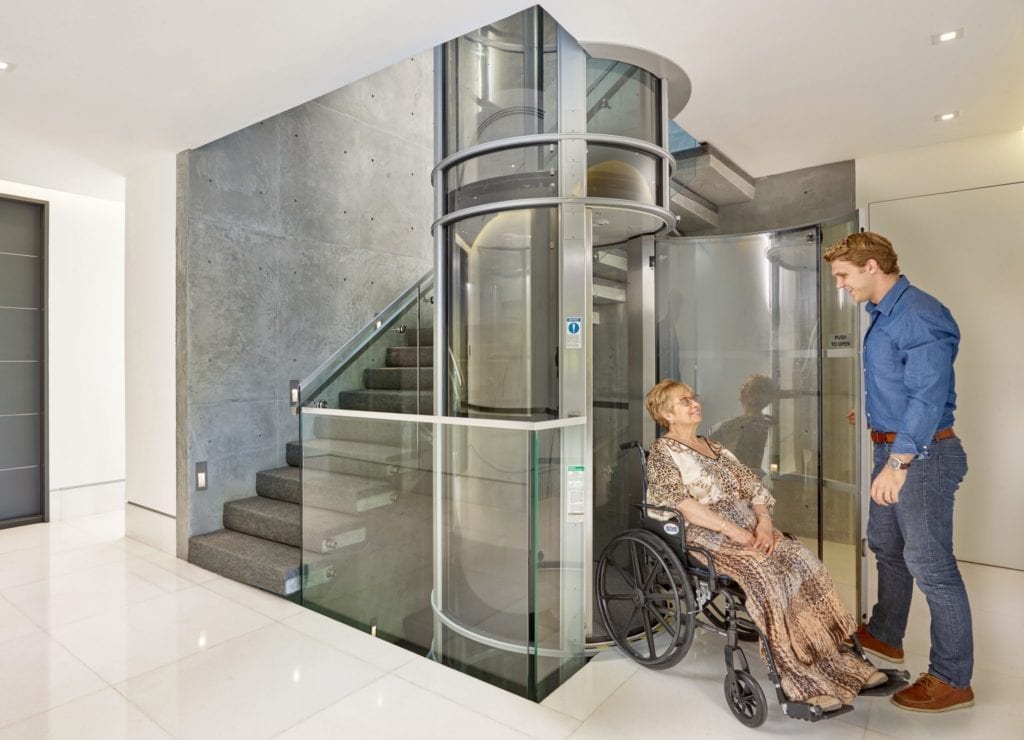
A wheelchair accessible home elevator is a residential elevator designed to carry a wheelchair user between floors. Unlike a stairlift, which usually requires the user to transfer onto a seated chair, a wheelchair accessible elevator allows the user to roll into the cab, travel between levels, and roll out at the landing.
The right elevator depends on the wheelchair size, available landing space, door opening, weight capacity, number of stops, and whether an attendant or caregiver may also ride with the user.
Wheelchair Lift vs. Wheelchair Accessible Home Elevator
A wheelchair lift is a broad term for a device that helps move a wheelchair user between levels. Common residential options include vertical platform lifts, which move straight up and down, and inclined platform lifts, which travel along a staircase.
Both can help with specific access barriers, such as porch entries, garage steps, short rises, or staircases. However, they differ from a wheelchair-accessible home elevator, which is designed for regular floor-to-floor passenger travel inside the home.
A wheelchair accessible home elevator may be the better long-term option when a wheelchair user needs everyday access to bedrooms, living areas, laundry rooms, or other levels of a multi-story home.
Types of Residential Wheelchair Lifts
Residential wheelchair lifts come in several forms, each addressing a different access challenge.
| Option | How It Works | Best For |
| Vertical platform lift | Moves straight up and down on a platform | Porches, garage entries, decks, or short rises |
| Inclined platform lift | Travels along a staircase on a diagonal track | Staircases with enough width and landing space |
| Portable wheelchair lift | Temporary or occasional access support | Small height changes or short-term needs |
| Wheelchair accessible home elevator | Enclosed elevator for floor-to-floor access | Daily movement between multiple levels inside the home |
A platform lift may work well for a specific access point. A wheelchair accessible home elevator is usually better suited for whole-home access and long-term mobility planning.
What Makes a Home Elevator Wheelchair Accessible?
A wheelchair accessible home elevator needs more than enough room inside the cab. Homeowners should also consider entrance width, landing clearance, door orientation, control placement, weight capacity, and the user’s mobility device.
Important factors include:
- Cab space: The elevator should provide enough room for the wheelchair user and, when needed, an attendant.
- Entrance opening: The door opening must allow the wheelchair to roll in and out safely.
- Landing clearance: There should be enough space at each landing for turning and positioning.
- Door configuration: In-line or walk-through doors may work better depending on the home layout.
- Weight capacity: The elevator must support the user, wheelchair, and any additional passenger.
- Controls: Controls should be easy to reach and operate.
A space and layout review can confirm whether the elevator location, landing clearance, and door configuration meet the user’s accessibility needs.
Which PVE Models Are Wheelchair Accessible?
PVE offers two wheelchair-accessible pneumatic vacuum elevators. Both are self-supporting, need no traditional shaft, pit, or machine room, and can travel up to 5 stops with a maximum total rise of 50 feet (15 meters).
PVE52
The PVE52 is a cylindrical wheelchair-accessible home elevator with a 52 11/16-inch outside diameter, a 43 1/2-inch interior diameter, and a 37-inch entrance opening. Lift capacity is 525 lbs, and door configurations may include in-line or walk-through options depending on the home layout. The PVE52 fits many wheelchair users along with an attendant when cab space and layout allow.
Cube
The Cube is a larger square-cab wheelchair-accessible home elevator that expands interior space and design options beyond the cylindrical footprint. Confirm current cab dimensions, entrance width, and lift capacity with an authorized PVE dealer for your specific project.
Both models share the same self-supporting design and can be a practical wheelchair-accessible elevator option for many existing homes. An in-home consultation should confirm placement, landing clearance, door orientation, electrical requirements, permits, and local code requirements before installation for either model.
Safety, Comfort, and Maintenance Considerations
Before choosing a wheelchair accessible elevator or lift, homeowners should review the user’s daily mobility needs, wheelchair size, number of floors, available space, and service requirements.
For the PVE52, important considerations include door configuration, cab space, lift capacity, landing clearance, and routine maintenance that may include checking door operation, seals, controls, safety systems, electrical components, and overall ride quality. Features such as interior lighting, ventilation, and accessible controls can also support everyday comfort and usability.
Like any residential elevator, the PVE52 should be maintained according to manufacturer recommendations by an authorized dealer or trained technician. Routine maintenance helps support safe, reliable operation over time.
Is a Wheelchair Accessible Home Elevator Right for Aging in Place?
A wheelchair accessible home elevator can be a strong long-term accessibility solution for homeowners who want to remain in a multi-story home. It can help keep bedrooms, bathrooms, laundry rooms, and main living areas accessible as mobility needs change.
For aging-in-place households, the benefit is not only wheelchair access. A home elevator can also support caregivers, reduce reliance on stairs, and make everyday movement easier for family members with limited mobility. Wheelchair access is one piece of a larger picture that includes home elevators for seniors and broader accessibility planning.
Final Thoughts on Wheelchair Accessible Home Elevators
A wheelchair accessible home elevator can make a multi-story home easier to use for wheelchair users, caregivers, and families planning for long-term accessibility. While wheelchair lifts can solve specific barriers, such as porches or staircases, a residential elevator may offer more complete floor-to-floor access inside the home.
The PVE52 is designed for homeowners who need wheelchair accessibility in a compact, self-supporting elevator. With no traditional shaft, pit, or machine room required, it can be a suitable option for many existing homes.
Before choosing an elevator, schedule an accessibility assessment to review wheelchair size, landing space, door configuration, number of stops, local code requirements, and long-term mobility goals. Budget planning also matters — home elevator cost varies by model, number of stops, and installation requirements.
Frequently Asked Questions About Wheelchair Accessible Home Elevators
What is a wheelchair accessible home elevator?
A wheelchair accessible home elevator is a residential elevator designed to carry a wheelchair user between floors. Unlike a stairlift, which usually requires the user to transfer onto a seated chair, a wheelchair accessible elevator allows the user to roll into the cab, travel between levels, and roll out at the landing.
What is the difference between a wheelchair lift and a wheelchair accessible home elevator?
A wheelchair lift usually helps a wheelchair user move past a specific barrier, such as a porch, garage entry, short rise, or staircase. A wheelchair accessible home elevator is designed for regular floor-to-floor access inside the home and may be better for long-term daily use in a multi-story house.
Which PVE elevator is wheelchair accessible?
PVE offers two wheelchair-accessible pneumatic vacuum elevators: the PVE52 and the Cube. The PVE52 has a cylindrical cab with a 43 1/2-inch interior diameter and a 37-inch entrance opening. The Cube uses a larger square cab that expands interior space and design options. Both are self-supporting, need no traditional shaft, pit, or machine room, and can accommodate an attendant when cab space and home layout allow.
How much space does a wheelchair accessible home elevator need?
Space needs depend on the elevator model, wheelchair size, landing clearance, door orientation, and number of stops. The PVE52 has a compact, self-supporting cylindrical design and does not require a traditional shaft, pit, or machine room, but a professional evaluation is still needed to confirm fit.
Can a wheelchair accessible elevator be added to an existing home?
Yes. Many wheelchair accessible home elevators can be added to existing homes, depending on the layout and available space. The PVE52 may be a practical retrofit option because it is self-supporting and does not require a traditional elevator shaft, pit, or machine room.
Do the PVE52 and Cube require a shaft, pit, or machine room?
No. Neither the PVE52 nor the Cube requires a traditional shaft, pit, or machine room. Their self-supporting design can reduce the amount of construction typically associated with traditional residential elevator systems.
Can a wheelchair user ride with an attendant?
Yes, depending on the wheelchair size, user needs, and available cab space. Both the PVE52 and Cube offer larger interiors than PVE’s smaller models and may accommodate a wheelchair user with an attendant when layout and capacity requirements are met. An in-home consultation confirms whether a specific wheelchair-and-attendant configuration works in a given home.
Is a wheelchair accessible home elevator good for aging in place?
Yes. A wheelchair accessible home elevator can support aging in place by making more of a multi-story home usable over time. It can help reduce reliance on stairs, support caregivers, and improve access to bedrooms, bathrooms, laundry rooms, and main living areas.