Skip to content >

- Key Takeaways
- Quick Answer
- How Does Each Type of Home Elevator Work?
- How Do the Main Lift Types Compare?
- What Are the Main Parts of a Home Elevator?
- What Safety Features Do Home Elevators Include?
- How Much Space Does a Home Elevator Require?
- How Is a Home Elevator Installed?
- How Do Residential Elevators Differ From Commercial Systems?
- Which PVE Elevator Models Are Available?
- FAQs About How Home Elevators Work
Key Takeaways
Drive systems: Home elevators use one of four main drive systems: hydraulic (fluid pressure), traction (cables and counterweights), winding drum (cable spool), or pneumatic (air pressure). Each system moves the cabin between floors differently and has different space, maintenance, and energy requirements.
Space and construction: Hydraulic and traction elevators typically require a machine room, a pit below the elevator, and a built shaft. Pneumatic vacuum elevators are self-supporting and require no pit, shaft, or machine room, making them practical for existing homes where structural modifications are limited.
Safety: All residential elevators sold in the U.S. must meet ASME A17.1 safety standards. Built-in features include automatic rescue devices for power cuts, door interlocks, emergency brakes, and weight limits.
Installation: Installation timelines range from several weeks for hydraulic systems requiring civil work to as few as 2 to 3 days for pneumatic vacuum elevators that rest on the existing floor.
Quick Answer
Home elevators work by using a drive system to move an enclosed cabin between floors. Hydraulic elevators use fluid pressure powered by a pump. Traction elevators use steel cables and a counterweight driven by a motor. Pneumatic vacuum elevators use changes in air pressure created by turbines to lift and lower the cabin. Each system includes guide rails, landing doors, safety mechanisms, and a control panel that manages floor selection and operation.
How Does Each Type of Home Elevator Work?
Four main drive systems power residential elevators. The right choice depends on available space, construction requirements, energy efficiency priorities, and long term maintenance expectations.
Hydraulic Elevators
Hydraulic home elevators use a pump to push hydraulic fluid into a cylinder, which drives a piston upward and raises the cabin. To descend, a valve releases fluid back into the reservoir, and the cabin lowers under controlled gravity.
Most hydraulic systems use a roped configuration: a hydraulic jack connects to a pulley, and steel cables run from the cabin to a fixed anchor point. This gives the system a 2:1 movement ratio, meaning each foot the jack travels moves the cabin two feet. The result is a smooth, quiet ride with relatively low motor demand.
Hydraulic lifts typically require a machine room adjacent to the shaft to house the pump, fluid reservoir, and controller. They also need a shallow pit below the lowest landing for the jack mechanism. These requirements mean more civil work and construction planning compared to some alternatives.
Traction Elevators
Traction elevators use steel cables (also called ropes) attached to the top of the cabin. The cables run over a sheave (a grooved pulley) powered by an electric motor. A counterweight on the opposite end of the cables balances roughly 40% of the cabin’s rated load, which reduces the energy the motor needs to lift passengers.
When the motor turns the sheave in one direction, the cabin rises and the counterweight descends. Reversing the motor lowers the cabin. The counterweight makes this system one of the most energy efficient options for homes with multiple floors.
Some traction systems are machine room less (MRL), with the motor and controller mounted inside the shaft. Traditional traction elevators require a dedicated machine room, usually above the shaft, along with extra space for overhead clearance.
Winding Drum Elevators
Winding drum systems work like a large winch. Steel cables attach to the cabin and wind around a motor-driven drum. As the drum rotates, cable spools onto it and the cabin rises. Reversing the drum unspools cable and lowers the cabin.
The drum and motor sit in a machine room adjacent to the shaft. Because there is no counterweight, the motor does all the lifting work, which increases energy consumption compared to traction systems. However, winding drum elevators are compact and suitable for installations serving two or three floors where space for a counterweight is not available.
Pneumatic Vacuum Elevators
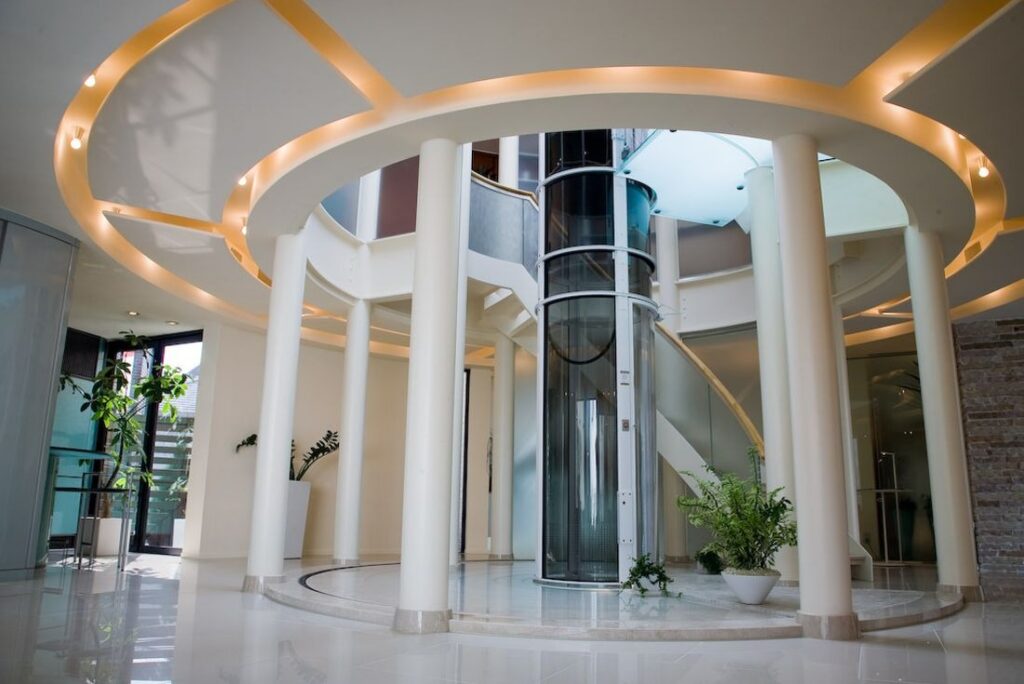
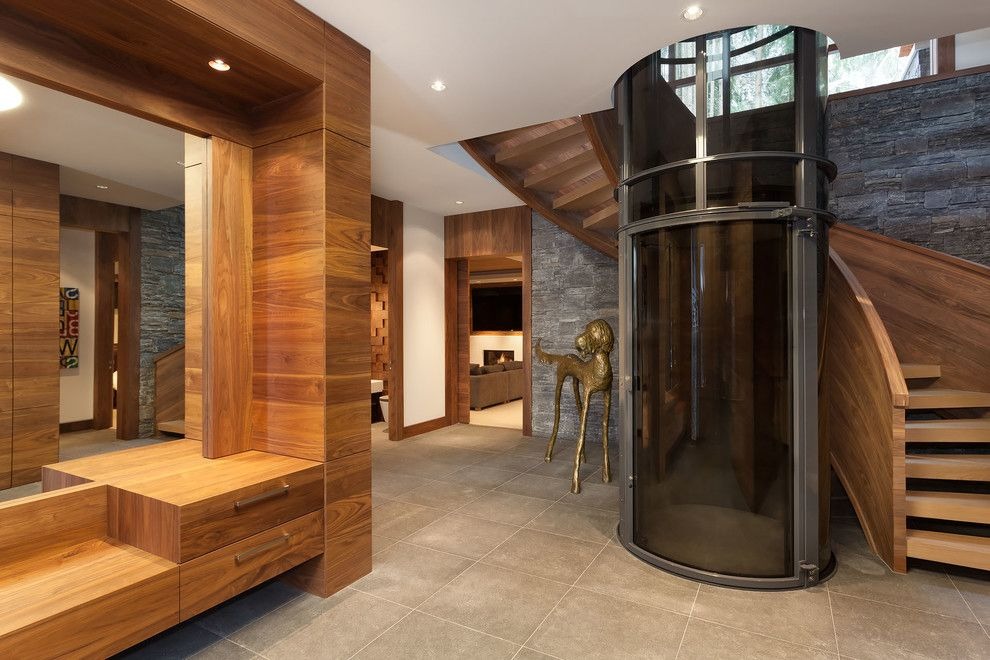
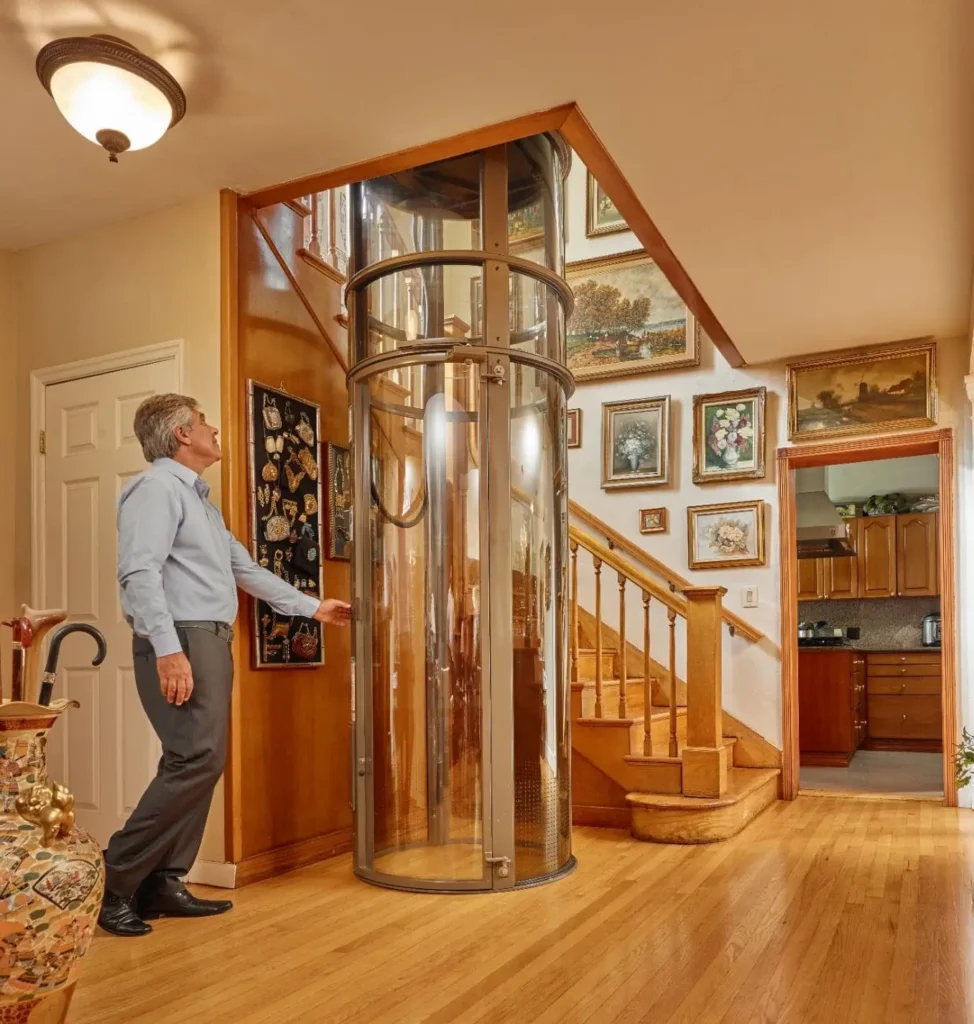
Pneumatic vacuum elevators work on a different principle from cable or hydraulic systems. The cabin sits inside a sealed, transparent cylinder. Turbines mounted above the cylinder remove air from the space above the cabin, creating a pressure difference. Higher air pressure below the cabin pushes it upward, similar to how a piston moves inside a syringe.
To descend, the turbines gradually reintroduce air into the upper portion of the cylinder. As air pressure equalizes, the cabin lowers smoothly under controlled conditions. A valve system regulates airflow to control speed, and brakes engage to hold the cabin at the selected floor.
Because the cylinder is self-supporting, pneumatic vacuum elevators do not require a pit, a built shaft, a machine room, or hydraulic fluid. The system rests directly on the existing floor, which makes installation practical in homes where structural modifications need to stay minimal.
During power cuts, air naturally re-enters the cylinder, and the cabin descends gently to the lowest landing. This gravity-assisted descent functions as a built-in automatic rescue device with no battery or backup generator required. Learn more about pneumatic elevator technology on the dedicated overview page.
How Do the Main Lift Types Compare?
| Feature | Hydraulic | Traction | Winding Drum | Pneumatic Vacuum |
| Machine room | Required | Required (or MRL) | Required | Not required |
| Pit | Shallow pit required | Pit required | Pit required | No pit |
| Built shaft | Yes | Yes | Yes | No (self-supporting cylinder) |
| Drive mechanism | Fluid pressure + piston | Cables + counterweight | Cables + drum | Air pressure + turbines |
| Energy efficiency | Moderate | High (counterweight) | Lower (no counterweight) | High (gravity-assisted descent) |
| Typical installation | Several weeks | Several weeks | Several weeks | 2 to 3 days |
| Structural modifications | Significant | Significant | Moderate | Minimal |
| Long term maintenance | Fluid checks, pump service | Cable inspection, lubrication | Cable and drum inspection | Minimal (no fluids or cables) |
What Are the Main Parts of a Home Elevator?
Although drive systems vary, most home elevators share these core components:
| Component | Function |
| Cabin | Enclosed car that carries passengers between floors |
| Drive system | Mechanism that raises and lowers the cabin (hydraulic, traction, drum, or pneumatic) |
| Motor or turbine | Powers the drive system |
| Guide rails | Vertical tracks that keep the cabin aligned during travel |
| Control panel | Interface for floor selection, door operation, and system diagnostics |
| Landing doors | Doors at each floor that lock when the cabin is not present |
| Safety mechanisms | Emergency brakes, door interlocks, automatic rescue devices, and weight sensors |
| Electrical supply | Provides power to the motor, controls, lighting, and safety systems |
What Safety Features Do Home Elevators Include?
Residential elevators sold in the United States must comply with ASME A17.1 safety standards, which set requirements for speed limits, weight capacity, door interlocks, and emergency systems.
Standard safety features across most home elevator systems include:
| Safety Feature | What It Does |
| Emergency brakes | Stop the cabin if it moves faster than the rated speed |
| Door interlocks | Prevent the cabin from moving unless all landing doors are fully closed and locked |
| Weight sensors | Disable operation if the cabin exceeds the rated weight limit |
| Automatic rescue device (ARD) | Lowers the cabin to the nearest or lowest landing during power cuts so passengers are not trapped |
| Emergency communication | Phone or intercom inside the cabin for contacting help |
| Battery backup | Powers lighting and communication during outages (some systems also power descent) |
| Slack cable or overspeed sensors | Detect cable failure or excessive speed and trigger the emergency brakes |
Pneumatic vacuum elevators include an inherent safety advantage during power cuts: because the system operates on air pressure, the cabin descends to the lowest landing by gravity when power is lost. No battery-powered motor or backup generator is needed for emergency descent.
Professional installation and regular maintenance help keep all elevator systems performing reliably. Most manufacturers recommend annual inspections.
How Much Space Does a Home Elevator Require?
Space requirements vary significantly across lift types. Hydraulic and traction systems need a built shaft (typically framed with drywall or enclosed in a hoistway), a pit excavated below the lowest floor, and often a dedicated machine room for the motor, pump, or controller. These requirements can consume extra space and increase construction costs.
Machine room less (MRL) traction systems reduce the footprint by mounting equipment inside the shaft, but they still require a pit and a built hoistway.
Pneumatic vacuum elevators have the smallest footprint because the self-supporting cylinder eliminates the need for a shaft, pit, or machine room. The cylinder requires only a circular opening in the floor above, plus overhead clearance for the turbine assembly. This makes them practical for existing homes where preserving floor space matters. For detailed measurements across all PVE models, see the residential elevator dimensions guide.
How Is a Home Elevator Installed?
The installation process depends on which elevator system you choose.
Hydraulic and Traction Elevator Installation
These systems require significant construction: excavating a pit, framing or pouring a shaft, running dedicated electrical circuits, and building or converting a machine room. A general contractor typically coordinates the work alongside the elevator installer. The process can take several weeks and may involve structural engineering review, especially in existing homes.
Pneumatic Vacuum Elevator Installation
Because pneumatic vacuum elevators are self-supporting and arrive pre-assembled, the installation experience is simpler. A typical installation involves:
1. Site evaluation to confirm ceiling height, floor opening location, and electrical access.
2. Cutting a circular opening in the upper floor (or floors) for the cylinder to pass through.
3. Positioning the pre-assembled cylinder sections and cabin on the existing ground floor.
4. Connecting electrical supply (standard household current).
5. Final testing, calibration, and inspection.
Most homeowners can expect the installation to take 2 to 3 days, with minimal disruption to daily use of the home. No pit excavation, shaft construction, or machine room conversion is needed.
How Do Residential Elevators Differ From Commercial Systems?
Residential and commercial elevators share the same operating principles, but they are engineered for different demands.
| Factor | Residential | Commercial |
| Load capacity | Typically 350 to 950 lbs | Often 2,500 lbs or more |
| Speed | Lower speeds (20 to 40 ft/min typical) | Higher speeds for tall buildings |
| Usage | Designed for a household (a few trips per day) | Built for continuous high-traffic use |
| Code standard | ASME A17.1 Section 5.3 (private residence) | ASME A17.1 general requirements |
| Construction | Can often fit existing homes | Requires dedicated infrastructure from the start |
| Machine room | Not always required (MRL and pneumatic options) | Usually required |
Which PVE Elevator Models Are Available?
Pneumatic Vacuum Elevators manufactures four residential elevator models, each designed for different household needs. All four are machine room less, require no pit or shaft, and use air pressure as the drive system.
| Model | Passengers | Cabin Shape | Weight Capacity | Wheelchair Accessible |
| PVE30 | 1 | Cylindrical | 350 lbs | No |
| PVE37 | 2 | Cylindrical | 450 lbs | No |
| PVE52 | 3 | Cylindrical | 525 lbs | Yes |
| The Cube | 2 | Square (36″ x 36″) | 450 lbs | No |
Pricing for PVE home elevators ranges from $35,000 to $100,000+, depending on the model, number of stops, and options selected. For a full breakdown, see the home elevator cost guide. To explore all models and request a free consultation, visit the home elevators overview page.
FAQs About How Home Elevators Work
Do home elevators use a lot of electricity?
Energy consumption varies by system. Traction elevators with counterweights and pneumatic vacuum elevators are the most energy efficient options because gravity assists the descent. Hydraulic systems consume more electricity because the pump works against gravity on every upward trip. For a single household, the electricity cost for any residential elevator is modest compared to other home systems.
Can a home elevator be installed without a pit?
Yes. Pneumatic vacuum elevators require no pit because the cylinder rests directly on the existing floor. Some machine room less traction systems require only a very shallow pit. Traditional hydraulic and winding drum systems generally require a pit below the lowest landing.
What happens if the power goes out while someone is inside?
All code-compliant residential elevators include an automatic rescue device (ARD) that brings the cabin to a landing during power cuts. In pneumatic vacuum elevators, this happens automatically through gravity: air re-enters the cylinder and the cabin descends to the lowest landing without any backup power.
How long does a home elevator last?
Most residential elevators are designed for 20 to 25 years of daily use with proper maintenance. Pneumatic systems may have lower long term maintenance requirements because they have no cables, hydraulic fluid, or counterweights to service.
Do I need a permit to install a home elevator?
In most U.S. jurisdictions, yes. Home elevator installations typically require a building permit and must pass inspection before use. Your installer or authorized dealer can advise on local permit requirements and code compliance.
Can a home elevator fit furniture or a wheelchair?
Most home elevators can accommodate small items like laundry baskets, groceries, or luggage. For wheelchair accessibility, a larger cabin is required. Among PVE models, the PVE52 is the wheelchair accessible option. Cabin dimensions and weight limits determine what each elevator can carry.