

For homeowners weighing an elevator against a life of stairs, electricity usage is one of several factors in the decision, alongside space, cost, and how environmentally friendly the system is. When people research home elevator electricity usage, they often run into statistics about commercial elevators, figures like elevators accounting for a meaningful share of a large building’s total electricity consumption. Those numbers describe office towers running banks of elevators continuously, all day, for hundreds of trips. A residential unit with a handful of daily trips is a different animal, and the two shouldn’t be compared directly.
Three technologies dominate the home elevator market: hydraulic systems that use a pump to raise the cabin, traction systems that use a motor with cables or belts, and pneumatic vacuum elevators that use an air pressure differential. Compared with these other types of elevators, PVE’s main structural difference is the absence of a shaft, pit, or machine room. As a manufacturer of air-driven, shaftless home elevators, PVE designs lifts with a lightweight cab, no counterweight, and no hydraulic oil. Those design differences affect how and when each system uses electricity. However, reliable public data comparing annual residential energy consumption across pneumatic, hydraulic, and traction models is limited. How much electricity elevators consume ultimately depends on technology, usage patterns, and equipment condition more than any single spec sheet number.
PVE’s three residential models have total turbine-motor ratings ranging from 3 kW to 7 kW, depending on how many turbine motors the model uses. Across these modern models, the PVE30 is built for single passengers, the PVE37 seats two, and the PVE52 is the wheelchair-accessible model in the lineup. These power figures come from PVE’s current published technical specification sheets.
| Model | Turbine Motors | Total Power Rating | Electrical Supply Required |
| PVE30 | 3 turbines | 3 kW | 220V, 25A, single phase |
| PVE37 | 5 turbines | 6 kW | 220 to 240V, 30A, single phase |
| PVE52 | 6 turbines | 7 kW | 220 to 240V, 40A, single phase |
That rating is the combined capacity of the turbine motors, not a continuous draw. It covers the motors themselves, not the cab lighting or other cabin equipment, which may draw electricity separately. It tells an electrician what circuit to run, not what shows up on a monthly bill. Those are two different questions, and the spec sheet only answers the first one directly.
The turbine motors are used during ascent. As we cover in our full explanation of how pneumatic elevator technology works, PVE’s turbines create the vacuum that lifts the cab. During descent, the cabin lowers with the help of gravity as air is admitted above the cabin, so the turbine motors do not power the downward trip. This leaves room for controls, lighting, and other electrical components that may still consume small amounts of power, even though the turbines themselves are not driving the cab down.
PVE doesn’t publish an exact ride duration or duty cycle, so we won’t manufacture a per-ride kWh number to look precise. What we can tell you: a full round trip pulls turbine current mainly during the ascent, for however many seconds that takes, not for the whole time the elevator is in use. Ride speed and travel distance both influence how long the turbines run per trip, and peak power demand occurs during that ascent window, not while the cab is parked or descending.
Because the turbines don’t run on the way down, there’s no motor to recover energy from during descent. Some commercial traction elevators use regenerative drives that capture energy on the way down, a form of energy regeneration; PVE’s gravity-assisted descent doesn’t have a motor phase to regenerate from in the first place.
One authorized PVE dealer estimates that a PVE37 used for 15 trips per day consumes approximately 217 kWh annually. At the April 2026 U.S. residential average electricity price of 18.83 cents per kWh (EIA), that would equal about $41 per year. At the dealer’s own assumed rate of 13 cents per kWh, the same 217 kWh comes to about $28 per year. Both figures use the same 217 kWh estimate; only the electricity rate changes between them, so the second number doesn’t independently confirm the first.
Because the dealer does not publish the full calculation methodology, including travel distance, number of stops, passenger load, ascent duration, whether “15 trips” means one-way or round trips, or standby consumption, this should be treated as an illustrative estimate rather than a guaranteed operating cost, and not as a verified real-world result. It appears to be a calculation repeated across dealer sites, not a metered field study.
Running electricity cost is a small piece of overall ownership cost. For the bigger installation and equipment numbers, see our home elevator cost guide. If you want a usage number specific to your household’s floor count and trip frequency, that’s a question for a PVE dealer, not something we’ll estimate for you here.
The honest answer is that a clean, apples-to-apples comparison isn’t available from public data. Published annual energy figures for elevators are almost all measured in commercial-building terms, tens or hundreds of thousands of door cycles a year, and don’t scale down cleanly to a home unit used a dozen times a day.
| Technology | How It Draws Power | Descent |
| Hydraulic | An electrically driven pump raises the cabin. | The cabin lowers through controlled fluid release. |
| Traction | A motor drives cables or belts, typically with a counterweight. | Motor-controlled; the counterweight offsets part of the load. |
| Pneumatic (PVE) | Turbine motors create the pressure difference needed for ascent, rated 3 kW to 7 kW total depending on model. | Gravity-assisted. Air is admitted above the cabin, and the turbine motors do not power the downward trip. |
Hydraulic elevators generally use an electrically driven pump to raise the cabin and lower it through controlled fluid release. Traction elevators use a motor, cables or belts, and typically a counterweight. Pneumatic elevators use turbine motors to create the pressure difference needed for ascent and rely on gravity-assisted descent. Actual energy consumption depends on the specific equipment, travel distance, load, controls, and frequency of use, so we won’t claim one technology definitively uses less electricity without comparable test data. For the full mechanical comparison, see our guide to pneumatic vs. hydraulic elevators.
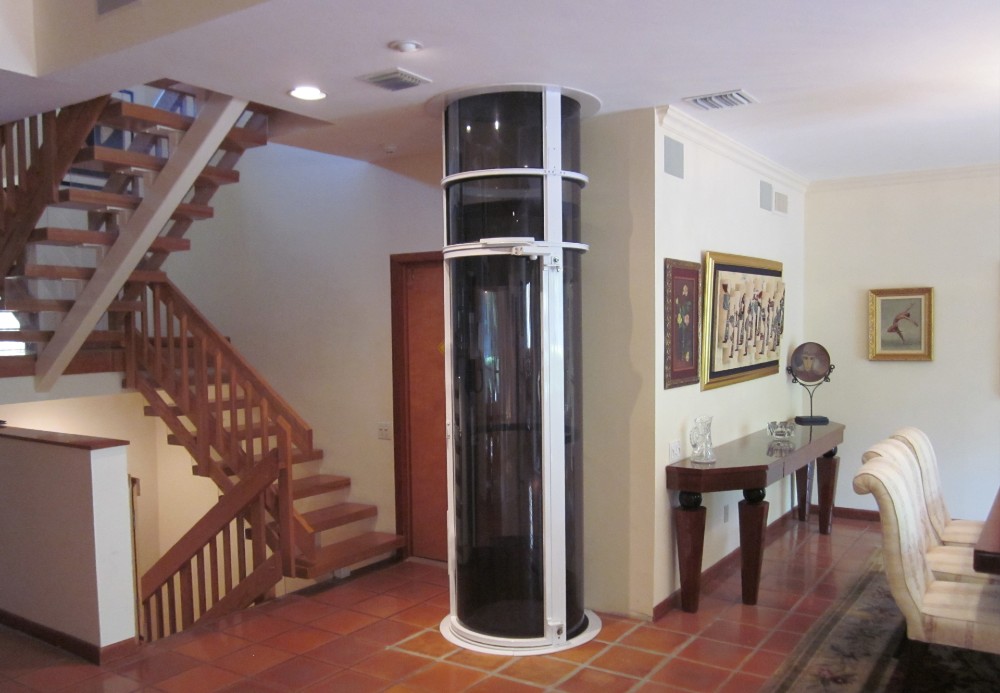
Several key factors determine how much electricity a residential elevator actually consumes in normal, day-to-day operation.
A few practical habits are worth considering, whether you’re a homeowner or managing a residential building on behalf of building owners. None of these are guaranteed to change your electricity bill by a specific amount since PVE doesn’t publish data isolating their effect, but they’re reasonable steps that support the elevator’s overall efficiency and, more broadly, a home’s overall building efficiency:
Yes, more than trip frequency does for most households. The 18.83 cents per kWh figure used above is a national average. As of April 2026, EIA data shows residential rates ranging from about 12.35 cents per kWh in North Dakota to about 46.62 cents per kWh in Hawaii, a nearly four-fold difference. Applied to the dealer’s 217 kWh per year estimate for a PVE37, that range works out to roughly $27 per year at the low end and roughly $101 per year at the high end, using the same illustrative estimate discussed above and each state’s average rate rather than a PVE-specific figure. Your actual local utility rate, not the national average, is what determines your real number.

The available dealer estimate suggests that normal PVE37 use may add a relatively modest amount to annual electricity costs, but actual consumption varies by travel distance, trip frequency, model, electricity rate, and installation. We don’t have a PVE-published figure precise enough to promise an exact number for your home.
Dedicated single-phase service: 220V at 25 amps for the PVE30, 220 to 240V at 30 amps for the PVE37, and 220 to 240V at 40 amps for the PVE52.
The turbine motors engage only during ascent. Controls, communications equipment, lighting, and other auxiliary components may also use electricity outside the turbine-motor rating, but PVE does not currently publish a standard standby-consumption figure, so we won’t estimate that amount here.
PVE offers a solar-power package, and compatibility with an existing solar, generator, or battery system may be possible depending on the model and electrical setup. The system needs to be sized for the elevator’s voltage, circuit, starting current, and peak ascent load, so confirm requirements with PVE, an authorized dealer, and a qualified electrician rather than assuming an existing system will work without changes.
PVE motors operate during ascent, and descent is gravity-assisted, so the turbine motors do not power the downward trip. Hydraulic elevators use an electrically driven pump to raise the cabin and lower it through controlled fluid release. A precise kWh-for-kWh comparison isn’t possible from publicly available data, since residential-scale hydraulic energy figures aren’t consistently published the way PVE’s motor specs are.
Low operating cost and aging-in-place accessibility are both factors buyers in some markets weigh favorably, though the resale impact depends heavily on local market conditions and buyer priorities. That’s a real estate question more than an energy one.
Logically, a heavier load asks more of the turbine motors during ascent, and PVE’s models range from the single-passenger PVE30 up to the wheelchair-accessible PVE52. PVE does not publish a figure quantifying exactly how much load changes electricity use per trip, so treat this as a reasonable expectation rather than a measured number.
Substantially. Applying the dealer’s 217 kWh per year PVE37 estimate to April 2026 EIA state averages ranges from roughly $27 per year in North Dakota to roughly $101 per year in Hawaii. National averages are a starting point, not a substitute for your utility’s actual rate.
When this Dallas family bought their home, the elevator came first. Parents were moving in, a wheelchair-accessible path to the second floor was essential, and the PVE52 Dallas Home Elevators made it possible.
When the buyer toured the house, the upstairs made all the difference. A multigenerational household needs every floor to be usable by everyone, every day. Without a safe and reliable way to reach the second level, the home simply would not work.
So a wheelchair-accessible elevator moved to the top of the list. Not a luxury. A requirement. It was the difference between a house that fit the family and one that did not.
PVE makes three pneumatic vacuum elevators. The PVE52 is the largest, and it is the only one designed for wheelchair access. That made the decision an easy one.
The cabin holds three passengers, or two when one is using a wheelchair, with a capacity of 525 pounds. For a family planning around a parent’s mobility, that was exactly the space they needed.
It is also beautiful. The PVE52’s panoramic cabin is wrapped in clear polycarbonate, giving riders an open, 360-degree view as they travel. In a finished home, it looks less like equipment and more like a centerpiece.
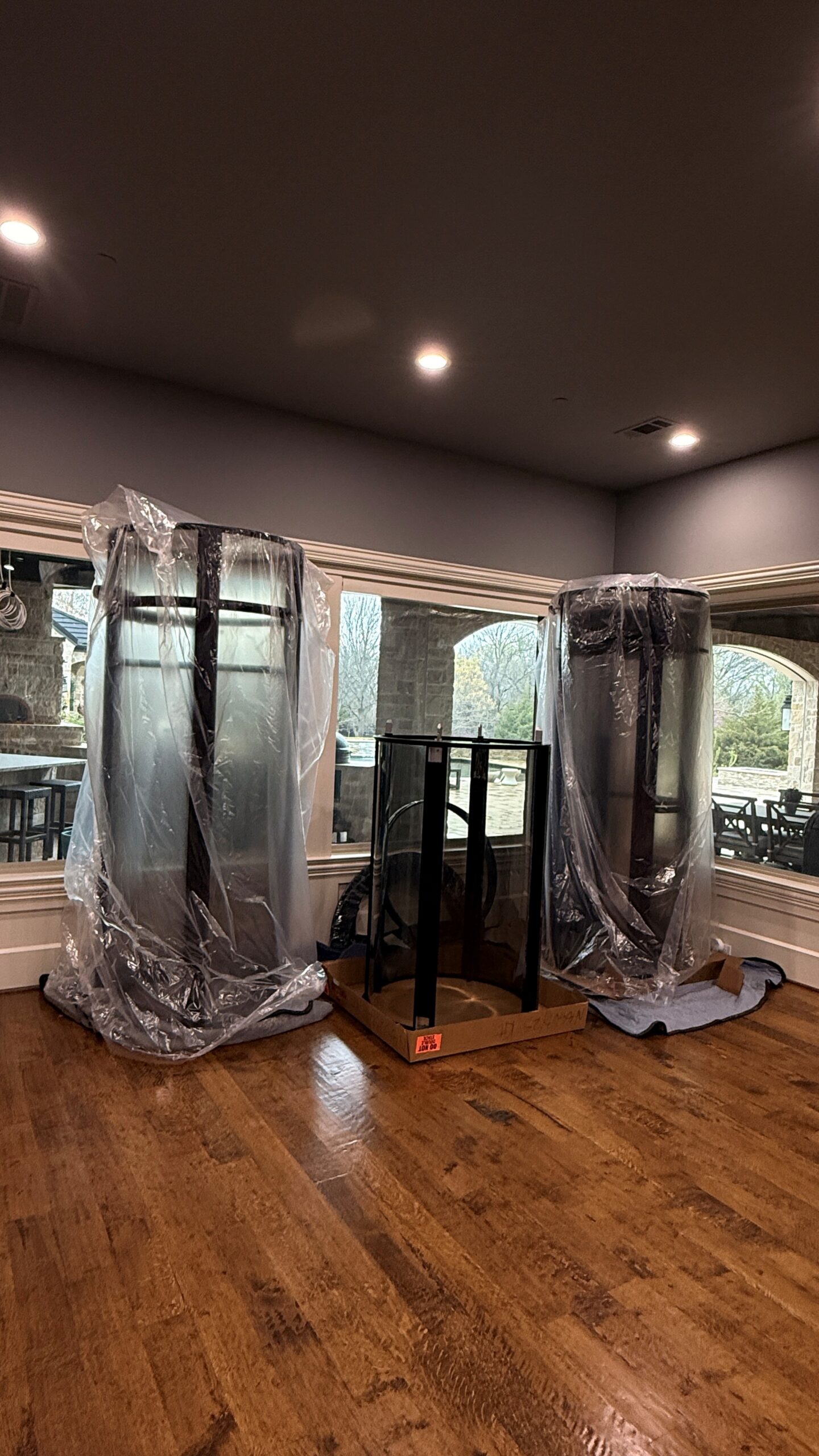
Here is what makes these elevators remarkable. The PVE52 rises and lowers on air pressure alone. No cables. No pistons. Fewer moving parts mean less maintenance for years to come.
It also needs no pit, no hoistway, and no separate machine room. The unit supports its own weight and rests on the existing floor. For this family, that meant adding an elevator without tearing the house apart to do it.
It is made in the United States and runs efficiently, two more reasons it made sense for the long term.
The PVE52 was installed through the floor, rising through a tidy opening between the first and second levels.
The before photos show an ordinary two-story interior. The finished photos tell a different story: the panoramic cabin in place, carrying the family smoothly from the first floor to the landing above. Because the elevator is self-contained, the footprint stayed small and the home stayed largely undisturbed.
Timing mattered on this new build, and Ascend treated it that way.
The team worked closely with the builder from the start, coordinating the floor opening, the electrical work, and the installation schedule. The entire PVE52 project was complete in seven weeks. For a custom, wheelchair-accessible elevator tied to a home purchase, that is a remarkable pace.
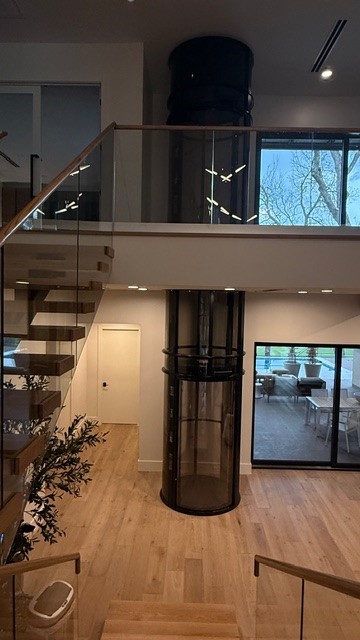
The best part came at the end.
Watching the parents travel comfortably between floors, settled into a home built around the whole family, was the reward. Smiles all around. The elevator gave everyone safe, independent access to both levels, and it brought three generations together under one roof.
That is what thoughtful accessibility makes possible: a home where everyone belongs, on every floor.
This PVE52 was installed by Ascend Residential Elevators, an authorized PVE dealer serving the Dallas–Fort Worth area. Led by Jay Lambert, a Certified Aging In Place Specialist, the Ascend team helps families find the right accessibility solution and installs it with genuine care. On this project, their close partnership with the builder kept everything on schedule.

Below are answers to common questions about multigenerational living and home elevators that were not fully covered in the sections above.
It is a home elevator that moves using air pressure. An air pump creates a difference in atmospheric pressure inside the cylinder, and that difference gently raises and lowers the cabin. It has fewer moving parts and uses less energy than a traditional cable or hydraulic elevator.
Yes. The PVE52 is the largest PVE model and the only one designed for wheelchair access. It holds a passenger in a wheelchair along with an attendant, with a capacity of 525 pounds.
No. It needs no pit, no hoistway, and no separate machine room. The self-supporting unit rests on the existing floor, which is why it installs with so little construction.
If power is lost, the cabin lowers gently to the bottom landing and lets passengers step out. This automatic descent is built right into the design.
It depends on the home and whether it is new construction or a retrofit. On this Dallas project, close coordination with the builder brought the full installation in at seven weeks.
More families than ever share a home across generations. Grandparents, parents, and children living under one roof brings warmth and shared resources, but it also creates real challenges around mobility, safety, and daily routines. A residential elevator can solve many of these problems by giving every family member safe, independent access to every floor.
This guide explains why multigenerational living is growing, what obstacles families face in multi-story homes, and how a home elevator fits into the picture as a practical, long-term home upgrade.
A home elevator lets children, adults, and aging parents move between floors safely without using stairs. It reduces fall risks for older people and eases physical strain on family caregivers. In multigenerational homes, an elevator helps every generation share one roof more comfortably by improving access to bedrooms, bathrooms, and living spaces. It supports independent living for grandparents and makes daily routines easier for busy families with several generations under the same house.
Multigenerational living means two or more adult generations live in the same home. This may include aging parents, adult children, grandparents, young children, or other relatives.
Many families choose this setup to share expenses, support older loved ones, help with childcare, or stay close as a family. But the home must work for everyone. If bedrooms, bathrooms, laundry rooms, or living areas are on different floors, stairs can become a daily barrier.
That is why many families look for home upgrades that improve safety, access, and independence.
Economic pressures and an aging population are pushing multigenerational housing into the mainstream across North America and around the world. Rising housing costs are a driving factor in this trend. When families pool income for mortgage payments, utilities, and groceries, the financial burden drops significantly. Financial savings occur when households share rent, utilities, and groceries, and multigenerational living can reduce financial burdens on families overall.
Healthcare costs play a major role too. Many families cannot afford assisted living for aging parents. Caring for older people at home becomes more practical when the home is set up for safe access. Longer life expectancy means more adults live into their 80s and 90s with mobility challenges, and their adult children often step in as caregivers.
Young people face their own pressures. By 2022, one-third of Americans aged 25-29 lived in multigenerational households. In 2022, 25% of Gen Z and Millennials lived with their parents, and one in four Gen Zers did so for financial reasons. Student debt and housing costs make it impossible for many young adults to afford living alone.
Cultural values also matter. In many communities, the extended family has always lived together. Daily interactions in multigenerational homes help maintain cultural heritage and family values across different generations and other generations that follow. For immigrants and certain ethnic groups, this intergenerational lifestyle has deep roots in culture and society.
COVID-19 accelerated the trend between 2020 and 2022. Adult children moved back in with parents. Grandparents moved in with younger generations for health monitoring and support. The interest in multigenerational housing among homebuyers reached 17% in 2025, a record.
Multigenerational homes need to support people of different ages, routines, and mobility levels. What works for young children or healthy adults may not work for aging parents or grandparents.
Common challenges include:
| Challenge | Why It Matters |
| Stairs | Can increase fall risk and limit access to upper floors |
| Shared spaces | May create privacy or routine conflicts |
| Caregiving needs | Can add physical and emotional strain |
| Mobility changes | May make bedrooms, bathrooms, or laundry rooms harder to reach |
| Future planning | Families need homes that can adapt over time |
A home elevator can help solve one of the biggest challenges: safe movement between floors.
Multigenerational housing works best when the layout supports all ages, from youth to grandparents with limited mobility. Smart design gives each person the ability to move through the home safely and with a sense of independence.
Key strategies include main-floor bedrooms for aging parents, wider doorways (at least 32 to 36 inches), step-free entries, good lighting throughout, and accessible bathrooms with grab bars. Central gathering areas like the kitchen and living room help several generations stay connected, while private suites give each generation their own space.
Vertical circulation matters enormously in a two- or three-story home. Stairs limit who can reach which floor. A residential elevator changes that equation entirely, giving every family member full access to the whole house. Many existing homes can be improved with targeted home modifications rather than full rebuilds, including adding a home elevator to connect floors safely.
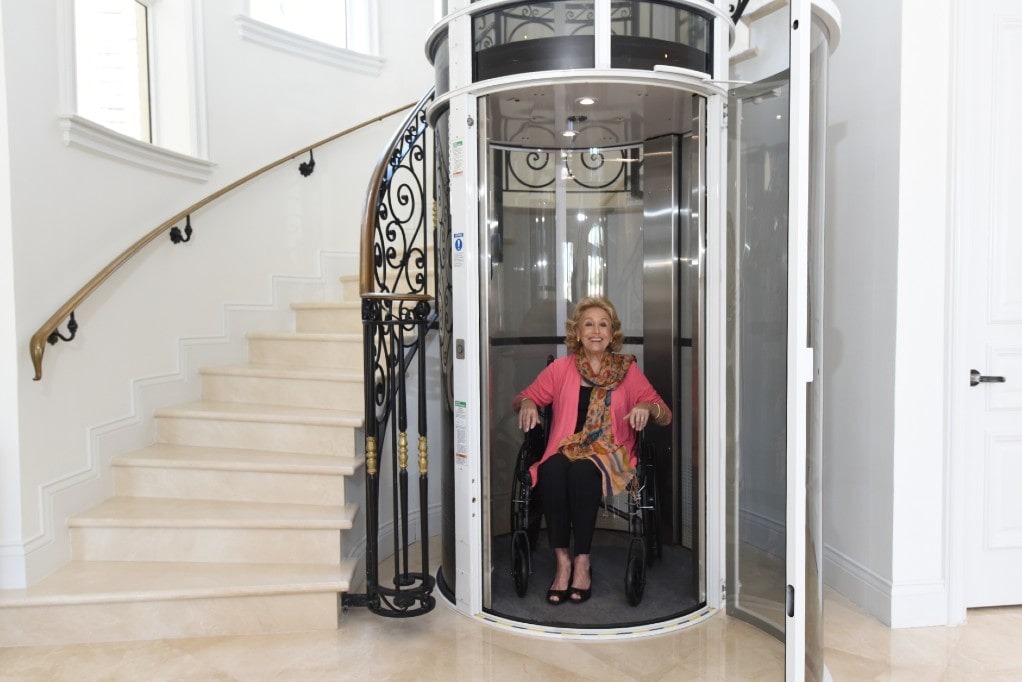
Stair-related falls are a serious concern in any multigenerational home. Over 14 million U.S. adults aged 65 and older fall each year, and stair falls among seniors cause roughly 278,000 emergency room visits annually. A home elevator eliminates the need to climb stairs at all.
With a residential elevator, aging parents can reach bedrooms, laundry rooms, and family spaces on upper floors independently. This supports aging in place, letting older adults stay in a familiar home through their 70s, 80s, and beyond. Living with extended family can combat loneliness and social isolation in older adults, and multigenerational living enhances emotional support and can improve mental wellness for seniors. But these benefits only work when grandparents can actually participate in daily life across the whole house.
An elevator also reduces reliance on family caregivers for basic movement between floors. Adult children no longer need to physically assist a parent up and down stairs multiple times a day. Wheelchair-accessible elevator models, such as PVE’s larger cabin, allow grandparents with walkers or wheelchairs to move safely between floors with a caregiver riding alongside. For more guidance, read our guide to home elevators for seniors and how they support independence in daily life.
Caregiving in a multi-generational home often means carrying children, strollers, laundry baskets, groceries, and medical equipment up and down stairs several times a day. This is exhausting and risky, especially on narrow or steep staircases.
A home elevator makes it easier for parents and grandparents to transport babies, car seats, and supplies between levels without lifting on stairs. It also helps family caregivers assisting relatives with mobility challenges. Safer transfers mean less back strain and fewer injuries for the person giving care.
In multigenerational living, elevators help coordinate daily routines across multiple floors. School runs, meal prep, and bedtime happen more smoothly when everyone can reach the kitchen, bedrooms, and living areas without waiting for help on the stairs. Friends and visiting relatives also benefit from easy access when they contribute to the household’s busy schedule.
Pneumatic Vacuum Elevators (PVE) manufactures air-driven residential elevators specifically designed for existing homes. Unlike traditional cable or hydraulic systems, PVE elevators use air pressure to move the cabin, creating vacuum above to lift and releasing air for a gentle descent.
The shaftless design is a major advantage for multigenerational families. There is no deep pit, machine room, or major structural overhaul needed. The elevator sits inside a self-supporting transparent tube that can be installed through floor openings with relatively minor construction. This point matters in homes where several generations are already living during the upgrade.
Installation often takes just two to three days once site preparation is complete, which limits disruption for families already in the home. The panoramic, 360-degree glass cabin allows caregivers to visually monitor riders such as children or older adults from outside the elevator.
PVE elevators are also eco-friendly. Power is mostly used for ascent, while descent relies on gravity and controlled air release. Energy consumption is low, and there is no hydraulic oil to leak or maintain.
Different family setups need different cabin sizes. A home with one aging parent has different needs than a household with a wheelchair user, a live-in caregiver, and grandchildren. Choosing the right model at the start saves time and cost later.
PVE offers three main residential elevator models. The PVE30 is a compact, single-passenger elevator built for smaller homes. The PVE37 carries two passengers and handles everyday family use. The PVE52 is designed for wheelchair users and caregivers, with a larger cabin that fits a wheelchair plus one standing rider.
| Model | Capacity | Best For |
| PVE30 | 1 passenger | Compact spaces |
| PVE37 | 2 passengers | Everyday family use |
| PVE52 | 3 passengers | Wheelchair users and caregivers |
Families should match elevator size to the needs of aging parents, visiting grandparents, or live-in caregivers. If a household expects increasing mobility challenges over the next decade, a larger model may be the responsible choice from the start. Visit the PVE30, PVE37, and PVE52 product pages for detailed measurements and planning guidance.
Many existing homes, including older houses and townhomes, can accept a shaftless residential elevator. You do not need a brand-new build or a complete renovation to make this happen.
Common placement options include through-the-floor installation alongside a staircase, in a corner of a living room, or inside a closet or bedroom. The small footprint of pneumatic elevators helps in tight floor plans common in urban and suburban homes built in the 1970s through the 2000s.
A typical project follows this timeline: initial home assessment, design and permitting where required, then a two- to three-day physical installation once the unit arrives. Because PVE elevators are shaftless and self-supporting, construction is lighter than with traditional systems. Disruption is usually limited, which matters when the family is already living in the home.
Safety and independence are the top priorities for families caring for aging parents under one roof. A residential elevator directly addresses both.
On the safety side, an elevator removes the leading cause of in-home fall injuries: stairs. PVE elevators include emergency stop features, backup lowering systems for power outages, and meet residential safety certifications. These features give families peace of mind, whether the rider is a grandparent, a child, or an adult recovering from surgery.
Independence improves because older adults and family members with mobility challenges can move freely without waiting for help. This supports aging in place and preserves the relationships that make multigenerational living work. Nobody wants to feel like a burden, and nobody wants to deal with the stress of constant physical assistance.
Home value benefits as well. Research shows multigenerational homes list for about 65% more than standard homes nationally. Accessibility solutions, including a home elevator, can make a property more attractive to future buyers in aging communities. While appraisals vary by market, thoughtful upgrades often lead to stronger resale interest.
Planning ahead is the single best thing families can do. Think about both present needs and what the next 10 to 20 years might bring in terms of age, health, and household changes.
Start by listing who will use the elevator: aging parents, young kids, adults recovering from injuries, wheelchair users, and visiting relatives. Consider whether a caregiver may need to ride along, which affects cabin size. A model like the PVE52 accommodates a wheelchair plus a standing rider.
Choose a location that serves the areas used most by several generations. Bedrooms, laundry, kitchen, and the main family room should all be easy to reach from the elevator. Talk to family members about their daily routines and where they spend time.
Consult with an authorized PVE dealer or installer early. They can review your home’s layout, structural details, and local permit requirements. Early planning can save both time and cost as the household ages and caregiving roles expand.
Pneumatic Vacuum Elevators has designed and manufactured the world’s only vacuum elevators since 2002.
PVE elevators use patented technology based on simple physics and innovative materials. They are self-supporting, machine-room-less, low maintenance, eco-friendly, and designed for plug-and-play installation.
PVE offers three residential elevator models:
With over 250 authorized dealers across five continents, PVE supports homeowners through planning, installation, and service.
Below are answers to common questions about multigenerational living and home elevators that were not fully covered in the sections above.
Pneumatic home elevators generally need less maintenance than traditional cable or hydraulic lifts because they have fewer moving parts and no hydraulic fluid. PVE recommends annual inspections, during which a technician reviews seals, pressure controls, and safety systems. Following the manufacturer’s maintenance schedule helps keep the elevator safe and reliable for all generations using it daily.
PVE elevators are designed to descend safely to the lowest level and open in a controlled way during a power loss. The system does not stop between floors with passengers trapped, which is especially important for aging parents and children riding alone. Homeowners can ask their dealer about specific backup and safety features available in their region.
There is some motor noise when the elevator travels, but it is generally quieter than traditional hydraulic pumps or cable-driven systems. Many multigenerational families install elevators near existing stairs or hallways where normal household noise is already present. Installers can suggest placement options to minimize disruption to bedrooms and quiet areas, keeping the home comfortable for everyone from birth to old age.
The process starts with an initial consultation and measurement, followed by permitting where required. The physical installation typically takes two to three days once the unit arrives. Because PVE elevators are shaftless and self-supporting, construction is often lighter than with traditional home elevators. This shorter timeline helps multigenerational families avoid long periods of disruption while continuing to live in the house.
While it may be possible to change models later, planning for future needs up front is usually more efficient. Installing a larger model from the start avoids the cost and disruption of a second installation. Families expecting increasing mobility challenges should speak with a dealer about cabin size and capacity before the project begins. Early planning saves both time and money as the population of the household ages and caregiving roles expand.
Multigenerational living allows grandparents, parents, young adults, and children to share resources and support one another under one roof. Families often choose this lifestyle to help with medical care, reduce economic stress, and strengthen relationships between different generations. Living together can also help older people maintain a sense of connection while allowing younger family members to benefit from the experience and support of parents and grandparents. A home designed for several generations can improve comfort, independence, and quality of life for everyone.
Installing a home elevator is a major decision, and many homeowners wonder whether they can claim a home elevator tax deduction to help offset the cost of a home elevator. The short answer: it depends on your medical situation, how you file your taxes, and whether the elevator increases your home’s value.
Summary: A home elevator can sometimes be tax deductible as a medical expense under IRS rules, but only when it is medically necessary and you itemize deductions on Schedule A. Any increase in your home’s fair market value must be subtracted from the total cost before calculating the medical expense deduction. Even then, unreimbursed medical expenses are deductible only to the extent they exceed 7.5% of your adjusted gross income (AGI). The primary benefit of the home elevator deduction is lowering your overall taxable income, but not every homeowner will benefit. Consult a tax professional for advice tailored to your situation and review IRS Publication 502 for the most current tax rules.
A home elevator may qualify as a medical expense deduction if it is primarily installed to provide medical care or accessibility for the taxpayer, spouse, or your dependents. Installing a home elevator can qualify for a federal tax deduction if certified as a medical necessity by a medical professional.
Most home improvements aren’t immediately tax deductible. However, the IRS treats certain accessibility-related home modifications, including residential elevators and porch lifts, as capital expenses that can count as medical expenses when the primary purpose is medical care.
IRS Publication 502 recognizes a range of accessibility-related home modifications as deductible capital expenses when their main purpose is medical care. Examples include:
Many of these modifications don’t add to a home’s value, so their full cost can qualify as a medical expense. Home elevators are the key exception: because they generally do add value, the deduction is calculated differently, which the next sections explain.
Home improvements for medical care can be deductible, but luxury or convenience upgrades are not. An elevator in a vacation home installed purely for comfort does not qualify. Home elevators designed for medical necessity can potentially be deductible under IRS rules, but eligibility is always fact-specific.
Medical necessity is the core requirement for a home elevator tax deduction and must be supported by a licensed health-care provider. Medical necessity must be established through a doctor’s written prescription — without it, the IRS has no basis to allow the deduction.
Common conditions where a doctor may recommend a home elevator include:
To establish medical necessity, you typically need a formal prescription for a home elevator, a letter of medical necessity on clinic letterhead, and medical records describing balance or mobility issues. Following a doctor’s advice is essential. The elevator’s primary purpose must be to provide access to essential rooms — bedroom, bathroom, kitchen — for a person with a disability.
The IRS and your tax professional may scrutinize mixed motives. If you install a panoramic luxury cab with features that go well beyond accessibility, it can weaken your position. Design choices that prioritize function, like PVE’s air-driven residential elevators built for safe, simple mobility, help support the medical expense position.
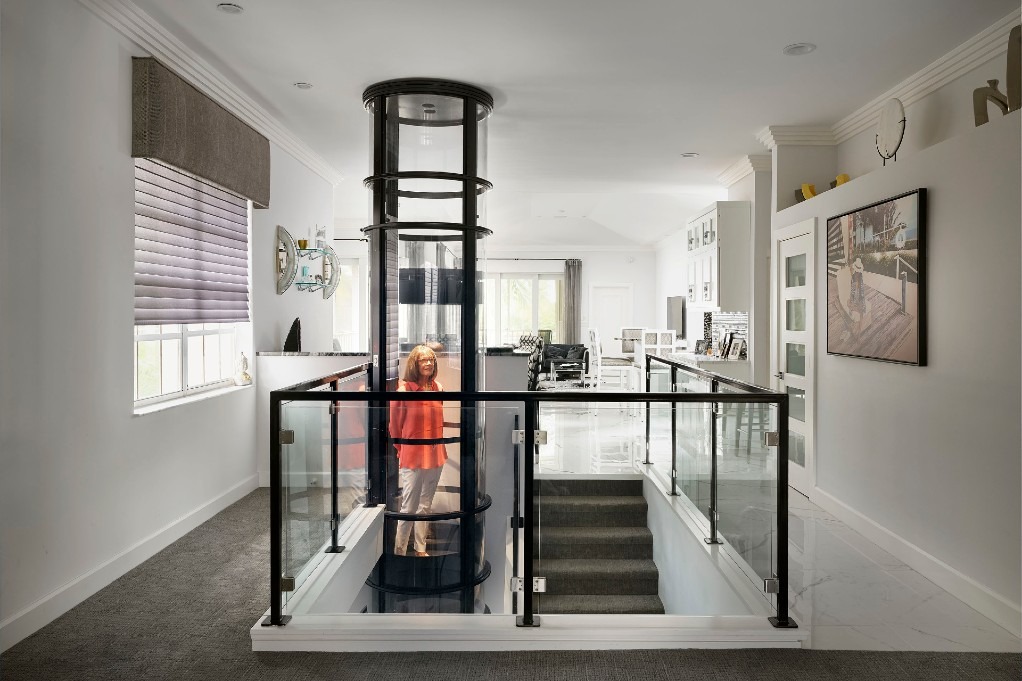
Before getting to the math, one thing has to be true: the elevator must be installed for a legitimate medical reason, for the care of you, your spouse, or a dependent, and is generally something a doctor has recommended. If the elevator isn’t medically necessary, none of the cost is deductible as a medical expense.
When it is medically necessary, the IRS treats it as a “capital expense,” and a special rule applies: because a home elevator generally adds value to your home, you can’t deduct the full cost. Per IRS Publication 502, the cost of the improvement is reduced by the increase in your home’s value, and only the difference counts as a medical expense.
The basic formula:
Deductible medical expense = Total cost (purchase + installation) − Increase in home’s fair market value
A simple example:
| Item | Amount |
| PVE elevator installed cost | $40,000 |
| Home value before installation | $500,000 |
| Home value after installation | $525,000 |
| Value increase | $25,000 |
| Potential medical expense | $15,000 |
If a professional appraisal shows the elevator increased your home’s value by $25,000, then only $15,000 of the total cost qualifies as a potential medical expense. A qualified appraisal establishing the home’s value before and after installation is what supports this figure, and IRS Publication 502 provides a Capital Expense Worksheet to help with the calculation.
Reaching a “$15,000 potential medical expense” isn’t the same as deducting $15,000 — two more IRS rules, the 7.5%-of-AGI threshold and the requirement to itemize, decide what you can actually claim. Those are covered in the next section.
A related benefit: once the elevator qualifies as a medically necessary improvement, the ongoing costs to operate and maintain it can also be included as medical expenses — even in years when the equipment itself adds no further value.
Because home elevators generally do add value, a fully deductible installation (one where the home’s value doesn’t increase at all) is rare — but not impossible, depending on the appraisal.
Even if a home elevator qualifies as a medical expense, you only get a tax break if you itemize deductions on Schedule A instead of taking the standard deduction — there’s no way around that requirement.
Under current federal law, unreimbursed medical expenses are deductible only to the extent they exceed 7.5% of your adjusted gross income (AGI). Here’s how that works in practice:
| Detail | Amount |
| Adjusted Gross Income | $120,000 |
| 7.5% threshold | $9,000 |
| Total medical expenses (including elevator) | $20,000 |
| Amount exceeding threshold | $11,000 |
| Potential itemized deduction | $11,000 |
This deductible medical amount is just one piece of your total itemized deductions, which together must exceed the standard deduction to actually lower your taxes. Because the standard deduction is relatively high, not every homeowner who installs an elevator will see a benefit, so a tax professional’s projection before you buy is worth getting.
This is general information, not tax advice. Tax situations vary, and the rules can change. Consult a qualified tax professional and see IRS Publication 502 before claiming any deduction.
If the elevator qualifies as a medical expense, certain related costs may also be treated as medical expenses under IRS guidance. Costs associated with operating and maintaining the elevator are deductible as long as the medical need exists.
Potentially deductible ongoing costs include:
Cosmetic upgrades, luxury cab finishes, or non-essential smart features generally do not qualify, even if the elevator’s basic function is medically necessary.
PVE’s air-driven, low-maintenance technology reduces both overall operating costs and the proportion of expenses you need to track. Keep separate, detailed records for all elevator-related invoices in case the IRS requests substantiation.
Standard durable medical equipment — walkers, hospital beds, wheelchairs — usually does not affect property value and qualifies more straightforwardly as a medical expense than a home elevator does. You can deduct costs for wheelchair-accessibility improvements like ramps and bathroom modifications without worrying about the value-increase calculation.
Are stair lifts tax deductible? Yes, stair lifts can be tax deductible as medical expenses, and they follow the same capital-expense rules as elevators, including subtracting any increase in home value. The same applies to platform lifts and other mobility equipment. The IRS does not maintain an exhaustive list but uses the general standard of whether an item’s primary purpose is medical care.
Medicare and private insurance coverage rules for medical equipment are separate from IRS tax rules. A device can be tax deductible as a medical expense even if insurance does not reimburse it. PVE’s wheelchair-accessible PVE52 model is often part of a broader accessibility plan alongside other modifications, such as widening hallways and interior doorways, installing a ground-floor bathroom, or adding safety features that together strengthen the overall medical deduction.
It helps to know the difference between a tax deduction, which lowers your taxable income, and a tax credit, which directly reduces the tax you owe. There is no broad federal tax credit just for installing a home elevator, even for medical reasons.
At the state and local level, though, some accessibility programs can help. A few examples of the kinds of programs that exist:
Because these programs, along with their eligibility rules and dollar limits, vary by location and change over time, check your state revenue department and housing agency websites for the programs and current terms in your area.
Other funding sources worth exploring include Medicaid Home- and Community-Based Services (HCBS) waivers, Veterans Affairs housing adaptation grants for eligible veterans, and state aging or disability agencies. Many of these prioritize stair lifts, ramps, or bathroom modifications, but some will consider a home elevator, particularly a compact, shaftless model, when it’s the most reasonable way to provide access between floors. You can also explore budget-friendly home elevator financing options to further reduce out-of-pocket costs.
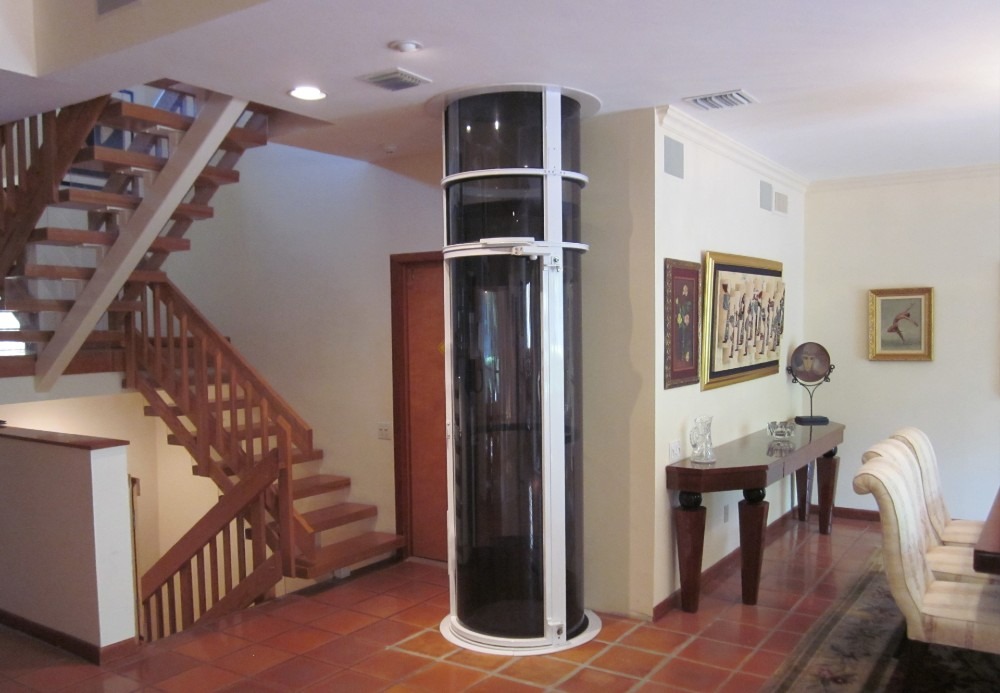
Here is a step-by-step overview for preparing to claim a home elevator as a medical expense on your federal return:
To claim a deduction for a home elevator, itemized deductions must be submitted on Schedule A of Form 1040. Add the net elevator cost (after subtracting the home-value increase) to your other unreimbursed medical expenses under “Medical and Dental Expenses.”
Retain all supporting documents for at least three years after filing or longer if advised by your tax professional. Because the rules for capital expenses, medical expenses, and potential capital gains tax interactions are complex, using a CPA or enrolled agent is strongly recommended.
Not every homeowner will meet the medical expense deduction rules, yet a home elevator can still be a smart long-term investment. Other modifications to your home can wait, but safe access between floors cannot.
Core PVE advantages that matter regardless of tax treatment:
These features connect directly to aging-in-place goals for seniors: enabling safe access to all floors, delaying or avoiding a move to single-story living, and preserving independence.
Contact Pneumatic Vacuum Elevators for a personalized quote and to discuss how your local dealer can coordinate with your tax and financial advisors.
Medical expense deductions are generally allowed only for improvements to the taxpayer’s primary residence where medical care is provided. Claiming a deduction for a vacation property is significantly more difficult and should be reviewed with a tax professional before proceeding.
Yes. The portion of the elevator cost that increased your home’s basis — the value increase you subtracted when taking the medical deduction — remains part of your adjusted basis. This can reduce capital gains tax when you sell, subject to normal home-sale exclusion rules.
Medicare’s definition of durable medical equipment usually does not include residential elevators, so they are not treated as DME for insurance purposes. However, the IRS may still treat the elevator as a medical expense if installed primarily for medical care.
The deductible amount is based on the cost of the elevator and installation, not how it is financed. Interest on personal loans is generally not deductible, so the focus remains on the qualified medical portion of the project cost.
Review the latest version of IRS Publication 502 and the instructions for Schedule A on IRS.gov. Verify any 7.5% AGI thresholds or rule changes with a tax professional each filing season.
For many seniors, leaving the home they’ve lived in for decades can feel less like a fresh start and more like a loss. And for many families, aging in place is not just an emotional preference. It can also be a practical, safe, and financially thoughtful choice when the right supports are in place.
Quick Answer: Aging in place means remaining in your own home as you grow older instead of moving to an assisted living facility or nursing home. Benefits include greater independence, emotional well-being, stronger community connections, potential cost savings, and the ability to maintain familiar routines. Home modifications, including residential elevators, can make aging in place safer and more sustainable.
Aging in place means an older adult chooses to remain in their own home and community, supported by the right mix of home modifications, in-home support, and long term planning. It is not about going it alone-it is about building a system that lets you live independently while staying safe. Around 90% of adults over 65 want to stay in their homes, and roughly 80% of older adults prefer aging in place over moving to a senior living facility.
The benefits of aging in place include:
Effective aging in place often requires a thoughtful plan and home adaptations. Modern accessibility solutions-including shaftless residential elevators from Pneumatic Vacuum Elevators (PVE)-can reduce stairs-related fall risk while helping seniors preserve independence well into their 80s and 90s.
Aging in place is an older adult’s choice to remain in their own home and community while receiving the level of support they need to stay safe and connected. It is not “doing everything alone.” Instead, it means tailoring support-family members helping with errands, professional in-home support for daily living assistance, technology for medication management, and home modifications for safety-so the older adult maintains control over daily life.
Unlike a nursing home or assisted living facilities, aging in place lets a loved one keep their own schedule, eat familiar meals, and stay in a familiar environment. Supportive services can include meal delivery, home health care, and transportation. Successful aging in place also includes access to healthcare and emergency services. Autonomy and familiarity can empower seniors to set their own routines, and that sense of agency is what the rest of this article explores in detail.
Emotional comfort and mental health are among the strongest advantages of aging in place. When people age in a house they have called home for decades, the familiar spaces-photos on the wall, the garden they planted, the kitchen where holidays happened-act as anchors for emotional stability.
Aging in place reduces stress and supports emotional well being. Familiar environments help seniors sleep and relax better, and seniors cherish emotional connections to their homes and possessions. This matters especially for older adults experiencing mild cognitive decline, where familiar surroundings reduce disorientation. Familiar homes help preserve cognitive function for seniors by keeping mental pathways active through daily routines.
Families may experience less stress knowing loved ones are in familiar surroundings rather than adjusting to the close quarters of an unfamiliar living facility. Studies over the last 10–15 years have linked aging in place with better mental well being and emotional health outcomes when social support and safety are in place. Aging in place enhances feelings of security and control-two pillars of well being that institutional settings often struggle to replicate.

Maintaining independence is often the primary reason many older adults want to age in place. At home, a senior can decide when to wake, what to eat for breakfast, and which hobby to spend the afternoon on-rather than fitting into a senior living facility’s schedule. Aging in place supports maintaining familiar routines and surroundings, which reinforces identity and dignity.
Being able to manage everyday tasks-preparing a simple meal, choosing clothing, watering plants-supports self-esteem and can slow functional decline. Adaptive tools like grab bars, adjustable beds, and compact residential elevators extend the years a person can safely navigate their house. Using help or technology does not mean losing autonomy; it often helps preserve independence longer. Aging in place allows seniors to manage daily needs independently when the right supports are in place.
Aging in place can support physical health by encouraging older adults to keep moving through everyday activities. Staying at home encourages physical activity through daily routines-light housekeeping, walking to the mailbox, light gardening, or climbing a few stairs safely. Natural movement at home promotes joint health and balance, and daily routines in familiar spaces support physical health over years.
A meta-analysis of 12 trials involving roughly 1,960 older adults found that home modifications were associated with a 7% reduction in fall risk. Predictable surroundings reduce fall risk further because the older adult knows every inch of the home. Consistent sleep and eating routines-easier to maintain at home-support immune function and chronic disease management.
Aging in place also reduces the risk of infections, since institutional settings expose residents to communal pathogens that homes do not. However, these physical health advantages depend on proactive safety planning; without modifications, stairs and clutter become hazards rather than healthy challenges.
One of the key advantages of aging in place is financial flexibility. For older adults with moderate care needs, remaining at home may cost less than moving into facility-based care, especially when family support, community services, and part-time in-home care are available. Home care costs vary widely by location and level of support, while assisted living costs can also differ significantly depending on the community and services included.
Aging in place may also allow families to make better use of existing resources, including a familiar home, established routines, and the surrounding community. Home modifications can range from smaller safety updates, such as grab bars and lighting, to larger accessibility investments, such as bathroom renovations or residential elevators. Some families may qualify for state, local, veterans, or Medicaid-based programs that help offset certain accessibility costs. Others may choose to explore home equity tools carefully with a financial professional.
Long term planning matters here. Building a realistic budget, reviewing insurance, and meal planning for nutrition should all be part of the strategy-especially as care needs may rise after age 80–85.
Aging in place helps older adults stay connected to the community they know-neighbors, local shops, parks, places of worship. Community connections help prevent isolation in seniors who age in place, and maintaining community connections helps prevent dementia in older adults. Seniors who remain socially engaged experience fewer depression symptoms, and social interactions contribute to better health and quality of life.
Aging in place allows seniors to maintain long-term friendships that took decades to build. Long-standing relationships with neighbors create informal safety nets: friends and neighbors notice if mail piles up or the older adult doesn’t appear at usual times. Transportation access-public transit, rides from family, or paratransit-is critical to keeping these connections alive. Community-based programs like senior centers, volunteer driver programs, and “village” networks offer numerous opportunities to stay connected.
Home modifications are central to making aging in place practical, not just aspirational. Simple adjustments can dramatically reduce fall risk and improve overall health outcomes. Installing grab bars can prevent falls in bathrooms, and non-slip flooring reduces fall risks for seniors at home.
Key modifications by area:
Certified Aging in Place Specialists can help with home modifications tailored to specific health needs. Many changes can be phased in gradually, starting in a person’s late 60s. For broader home accessibility upgrades, a professional assessment helps prioritize what matters most.
Safe access to every level of a multi-story house is one of the most overlooked factors in making aging in place work. Stair-related falls are a leading cause of injury among older adults, and losing access to upstairs bedrooms or bathrooms often forces a premature move.
Solutions range from stair lifts to ramps to compact residential elevators. Pneumatic Vacuum Elevators (PVE) manufactures shaftless, air-driven home elevators for seniors that can typically be installed in 2–3 days with minimal construction. Key benefits relevant to aging in place include a small footprint, no pit or machine room, panoramic visibility that reduces claustrophobia and aids family caregivers, wheelchair-accessible models, and energy-efficient operation.
A residential elevator is not just a luxury item-it is a long-term accessibility investment that can allow an older adult to safely use upper floors well into their late 80s or 90s. For homeowners comparing options, understanding home elevator vs. stairlift trade-offs is a practical first step.
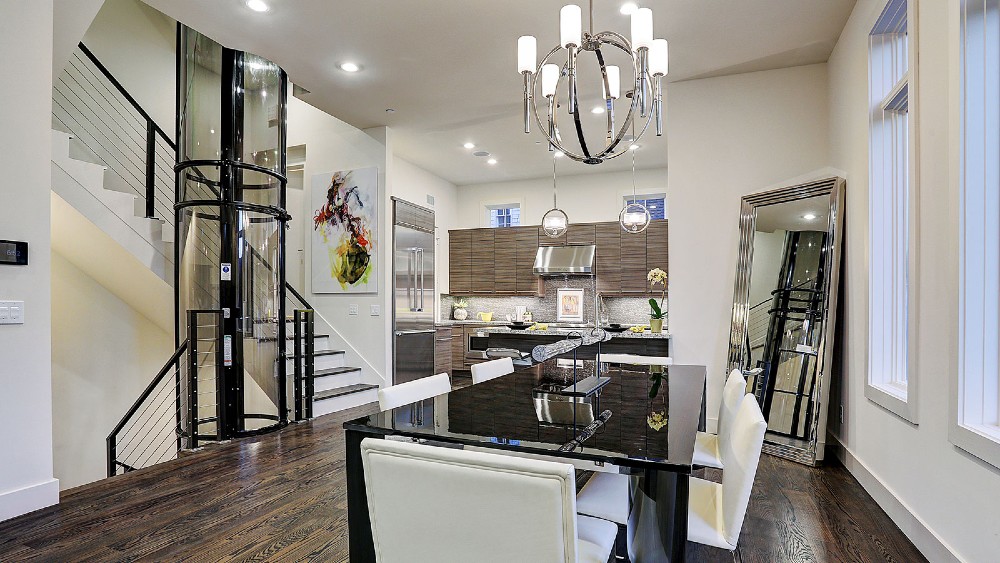
Aging in place can either protect or harm mental health depending on how well social isolation, grief, and changing abilities are addressed. Aging in place provides families with the opportunity for more meaningful connections with seniors-regular visits, shared meals, and involvement in daily life rather than scheduled facility visiting hours.
Practical strategies to combat feelings of loneliness include scheduled calls from a loved one, virtual religious services, phone-based check-in programs, and senior-friendly exercise classes streamed online. When signs of depression or anxiety appear, professional support-geriatric counselors, support groups, or primary-care screening-should be sought promptly. Being proactive about mental health is a major part of long term planning, not an afterthought to physical safety or home maintenance.
Simple, user-friendly technology can improve the quality of daily life for older adults who want to live independently. Smart home devices can enhance safety for aging adults. Key categories include:
Technology should be introduced gradually-one or two devices at a time-to reduce frustration. Some modern accessibility products, including residential elevators, can integrate with smart home systems for maintenance alerts and monitoring. Privacy matters: configure devices with minimal data sharing and discuss consent and boundaries with the older adult before installation.
The advantages of aging in place are greatest when planning begins early-often in a person’s late 60s or early 70s. A realistic aging in place plan includes a home safety assessment, medical care coordination, emergency plans, transportation strategies, and financial planning for the next 10–20 years.
Regular check-ins-yearly family meetings or care reviews-help determine if independent living remains the safest choice as cognitive function, mobility, or overall health changes. Some situations-advanced dementia without 24/7 support, repeated dangerous falls, or complex medical needs-may mean aging in place is no longer the best option. The goal is always the older adult’s quality of life and dignity, whether that means staying in their own home or considering another setting.
PVE is a residential elevator manufacturer specializing in vacuum-powered, shaftless elevators designed to enhance safe aging in place in multi-story homes. Their air-driven residential elevators use pressure differentials to move between floors, requiring no pit, machine room, or major structural changes-which makes them ideal for retrofitting into an existing house.
PVE offers models for single passengers, multiple passengers, and wheelchair users, allowing homeowners to choose a solution that matches current and anticipated mobility needs. Safety features include compliance with recognized certifications, built-in emergency braking, and transparent walls that let riders and family caregivers see each other during travel.
If stairs are becoming a barrier for you or a loved one, consider a professional home accessibility assessment. Exploring whether a compact PVE residential elevator fits your budget and floor plan could be the step that keeps your home a place you can grow older safely. You can review PVE’s home elevator cost guide for detailed pricing and key factors.
These FAQs address common practical questions that families ask when deciding whether aging in place is right for their loved one and how to support aging safely at home.
Planning ideally begins in the late 60s or early 70s-well before major health problems appear. Start with a home safety walk-through, a basic financial review, and open family conversations about preferences for the next 10–20 years. Waiting for a fall or hospitalization limits your options and raises cost.
Watch for frequent falls or near-falls, unpaid bills piling up, spoiled food in the kitchen, missed medications, or confusion about familiar daily tasks. If these signs appear, schedule a medical evaluation and a professional home safety assessment to determine what extra support or modifications are needed.
Consider involving primary care physicians, occupational therapists, and Certified Aging in Place Specialists who recommend modifications tailored to specific health needs. Accessibility-focused contractors, residential elevator specialists like PVE dealers, and local aging services agencies can coordinate physical changes and connect families with community resources.
It can be realistic if mobility barriers-especially stairs-are addressed early. Solutions include stair lifts, reconfigured main-floor living areas, or compact residential elevators. Shaftless, air-driven elevators from PVE are specifically designed to make multi-level homes safer without major construction.
Approach the conversation with respect, asking what independence and emotional comfort mean to them. Emphasize that modifications are meant to keep them at home longer, not push them out. Start with small, non-threatening changes-like better lighting or installing grab bars framed as “for everyone’s safety”-and involve a neutral professional like an occupational therapist if needed.