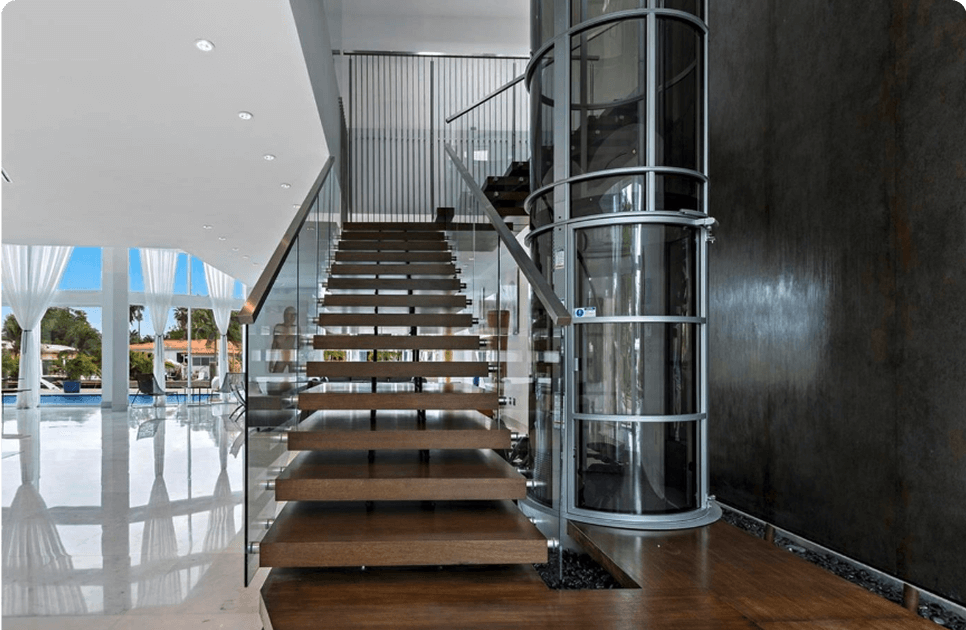
- Putting Safety at the Forefront of PVE Home Elevators
- How PVE's Air-Driven Technology Boosts Safety
- Essential Safety Features in PVE Home Elevators
- Proper Installation & Ongoing Maintenance
- Building Codes & Home Elevator Safety Codes
- Choosing a Safe PVE In-Home Elevator Model for Your Home
- Your Safety Checklist for PVE Homeowners
- Are PVE home elevators up to code?
- Wrapping Up
- Frequently Asked Questions: PVE Home Elevator Safety
As more homeowners install residential elevators for convenience, accessibility, and aging-in-place solutions, safety has become a top concern. Modern home elevators are designed with advanced safety features, strict building codes, and reliable engineering that make them a secure option for multi-story living.
From emergency braking systems to backup power and child-safe controls, today’s residential elevators prioritize user protection while improving mobility and home value. Understanding how safe home elevators really are can help homeowners make informed decisions with confidence.
Pneumatic Vacuum Elevators have been in use for over 20 years. In that time, they’ve built a reputation for providing safe, reliable home elevators for residential use – and they’re not done yet.
This guide will walk you through how PVE home elevators work, the safety features they include, and what homeowners should know to ensure safe, reliable use.
Putting Safety at the Forefront of PVE Home Elevators
When people ask, “Are home elevators safe?” the real question is: what kind of elevator are they talking about, and who installed it?
The answer? Home Elevators by PVE. PVE makes air-driven home elevators specifically for private homes that do not require an elevator shaft. With over two decades of experience and installations in more than 90 countries, PVE focuses on providing fully certified, space-saving home elevators that meet strict safety and building requirements for residential use. Safety is prioritized in every aspect of PVE’s design and installation process to ensure no hidden hazards occur.
So what makes PVE elevators tick?
- They’re designed from the ground up as residential elevators, not commercial or ADA-compliant systems. These are not commercial elevators.
- They get installed and serviced by licensed, trained professionals through PVE’s authorized dealer network.
- They’re equipped with safety devices and emergency features to keep everyone safe during elevator use.
As the elevator manufacturer, it is recommended to have your elevator installed by an authorized dealer, have a qualified elevator inspector examine the unit and ensure the homeowner keeps it properly maintained. Designed to be an incredibly safe lift, critical safety devises like an actively connected landline telephone located inside the elevator cab ensure absolute safety for all family members and children. For vacation rental homes, it is recommended to provide occupants of the vacation rental with instructions on how to operate the elevator.
How PVE’s Air-Driven Technology Boosts Safety
Unlike traditional elevators, which rely on big machine rooms or mechanical assemblies, PVE home elevators use pneumatic technology to safely move the elevator cab up and down the elevator shaft. Powered by air, these home elevators have a flawless safety record to day with no fatal injuries or serious injuries to homeowners worldwide. That’s one reason why PVE emphasizes safety, reliability, and low maintenance in the residential elevator space.
Key advantages of PVE’s technology from a safety angle include:
- Self-supporting cylindrical shaft. Unlike traditional elevators, which need a dedicated shaft for installation and structural support, PVE’s home elevators use a self-supporting cylindrical structure. That means no separate shaft is necessary, which simplifies installation, reduces construction complexity, and ensures all safety-critical components are factory-engineered and tested. This is key to ensuring no potential dangers, risks or injuries occur to the passengers.
- Fewer moving parts, PVE’s air-driven design, and compact machinery help reduce the number of complex parts compared to many traditional systems or even stair chairs. Fewer parts can translate to fewer potential points of failure when properly installed and maintained.
- Safely descending during power loss. On models like the PVE52, if power is lost, the elevator is designed to safely descend to the lowest landing, where a mechanical door lock allows passengers to exit, preventing riders from being stuck or stranded in mid-travel. The ground floor doors are designed to automatically open once the elevator cab arrives at that level.
All of these design choices reflect PVE’s focus on providing safe, user-friendly residential elevators that fit seamlessly into existing homes.
Essential Safety Features in PVE Home Elevators
Home elevators must adhere to safety codes that dictate weight limits, speed, travel distance, and safety features. PVE highlights several safety features and best practices across its resources and safety guides. While details can vary by model and market, the company emphasizes several key elements that support safe operation. These features are designed to prevent passengers from becoming trapped in the elevator due to malfunctions or power outages.
1. Door & Entry Safety
Safe door operation is a top priority in any home elevator. PVE’s educational content stresses that and the following tips are ideal for all homeowners:
- Doors must work smoothly without sticking, delays, or irregular motion. Special attention should be paid to ensure no one is in the gap between doors when the elevator is called to another floor, as this can pose a safety risk.
- Homeowners should never operate the elevator if the doors look damaged or do not close properly. Elevator cabins may not always stop perfectly flush with the floor, creating a trip hazard.
- Any irregular door behavior is a reason to call an authorized tech.
Elevator car door safety also aligns with general best practices, such as keeping the entry area clear of objects and ensuring nothing obstructs door travel at any landing.
2. Emergency Controls & Communication
Most fully certified residential elevators include emergency stop controls and alarms; PVE’s safety guide notes that home elevators typically come equipped with features such as:
- Emergency stop buttons
- Alarms or internal communication devices
- Clear safety instructions and procedures in the user manual
PVE recommends that homeowners:
- Review the User Manual for their elevator.
- Ensure every member of the household knows where the emergency controls are and how to use them. This is also incredibly important to prevent lifelong injuries for occupants of vacation rental homes where they may not be familiar with these critical safety devices.
3. Power-Outage & Backup Options
PVE’s residential elevator safety guide & product pages make it clear that correctly set up systems are designed to behave predictably in the event of a power outage, for instance:
- An automatic controlled descent down to the lowest landing in the event of power loss while the home elevator cabin is in motion.
- Mechanical door locks that allow the rider to safely exit once the elevator car door has reached a the ground floor.
- In many cases, you can discuss battery backup power upgrades or solar panel integration with your local PVE dealer if they’re available in your area. Backup battery power allows home elevators to safely move to the lowest landing during a power outage.
4. Weight Limits & Overload Safety
Whether for a stair lift or an existing elevator, respecting weight limits is absolutely key to keeping your mobility devise safe. Depending on the manufacturer, make and model, residential elevators typically have a weight capacity between 400-1000 lbs. PVE’s weight-limit instructions say that:
- Every elevator has a clearly marked maximum weight capacity that you should always stick to.
- Overloading the elevator can put significant strain on its mechanical components and disrupt its operation.
- Many modern elevators are equipped with an overweight sensor that prevents the unit from operating when its capacity is exceeded.
PVE advises you always to follow the posted capacity for your specific model and to ensure passengers capacities are also adhered to avoid issues or injuries.
Proper Installation & Ongoing Maintenance
As the elevator manufacturer, PVE stresses that home elevators should only ever be installed and maintained by licensed elevator installers who know what they’re doing.
When it comes to safety and educational content, PVE makes it clear. Homeowners are encouraged to call their local PVE dealer for a free consultation to discuss their home elevator needs and safety requirements. This includes if they experience an inability to access doors or find the elevator cabin in an unusable position. If the elevator cabin is not traveling after being called to another floor, contact your local dealer to service your elevator. Regular maintenance is essential for ensuring the safety and proper functioning of home elevators.
The Importance of Installation by an Authorized Dealer
PVE advises that:
- Your elevator should be installed by a properly licensed and qualified installer who’s familiar with local building codes and PVE specs.
- Authorized distributors handle permits, structural requirements, and code compliance for their area. This includes having a qualified elevator inspector examine the unit.
- The same local dealer will then be your go-to person for all future service and inspections.
If your home elevator is installed correctly, all safety features, controls, and structural supports will be configured appropriately from the outset.
Regular Maintenance & Safety Checks For Residential Elevators
PVE’s residential elevator safety guide breaks down several ongoing steps you can take to ensure safe elevator operation:
Consider following these tips to make sure your home elevator remains safe & reliable:
- Schedule regular maintenance with a qualified, certified technician in accordance with the manufacturer’s recommendations.
- If your elevator starts making unusual noises, moving irregularly, or hesitating – don’t ignore it, address it straight away.
- Always keep the elevator cabin and surrounding areas free of clutter to avoid operational issues.
- Check that the elevator car doors are working properly & give your dealer a call if you notice anything out of the ordinary.
Following these steps will help keep your elevator safe for everyone in the home.
Building Codes & Home Elevator Safety Codes
Home elevator safety is more than choosing the right model or relying on proper installation – it’s also about ensuring your residential elevator complies with all relevant safety standards. These codes, established by organisations such as the Consumer Product Safety Commission (CPSC), are designed to safeguard homeowners and their families from potential safety hazards, including serious injury or death.
One of the most critical safety issues addressed by building codes is the hazardous gap between the exterior landing door and the interior elevator car door or gate. This space, if left unguarded, can be a dangerous gap – especially for children – that leads to tragic accidents or serious injuries.
To avoid this, many modern home elevators are equipped with space guards and other safety features that eliminate or significantly reduce the risk of entrapment. A qualified elevator inspector should inspect your elevator to ensure the space guards are correctly installed and that it complies with all current safety codes.
In addition to space guards, many home elevators are equipped with other essential safety devices. Interlocks ensure that the elevator doors, including elevator car door, can’t open unless the cab is securely at the correct floor, and gates prevent the elevator from moving if the door or gate is open or obstructed. Backup power systems & emergency lighting are also essential, providing peace of mind that, in the event of a power disruption, passengers won’t be trapped inside the elevator in an unusable position.
Regular maintenance & inspections by a qualified elevator inspector are vital for identifying and addressing potential safety hazards before they become serious problems. This can include reviewing the machine room and other critical safety devices.
Homeowners should schedule routine checks and promptly address any issues with elevator doors, interlocks, or other safety components. Having a landline phone nearby and a clear emergency plan in place will also increase safety for everyone in the home.
By prioritizing elevator safety, following building codes, and working with reputable residential elevator installers & manufacturers, homeowners can significantly reduce the risk of accidents. Installing space guards, scheduling regular maintenance, and staying vigilant about potential hazards are essential to ensuring your home elevator remains safe, reliable & convenient for everyone in the home.
Choosing a Safe PVE In-Home Elevator Model for Your Home
At PVE, we offer a range of home elevator models, each designed with safety and practicality in mind for residential use:
PVE30 – Single-Passenger Home Elevator
- A very compact, space-saving solution for homes that need greater versatility and more flexibility than a stair lift.
- Perfect for one person, the PVE30 model is ideal for tiny floor plans where space-saving and accessibility are top priorities.
PVE37 – Two-Passenger Home Elevator
- A versatile and dynamic lift that comfortably transports two people.
- Offers a bit more room inside than the PVE30, still keeping its footprint super small – perfect for multi-story homes.
PVE52 – Three-Passenger / Wheelchair-Accessible Home Elevator
- This one’s our largest residential model, built to accommodate up to three passengers or a standard wheelchair with an attendant inside.
- Designed with accessibility in mind, the cabin is slightly larger to accommodate traditional wheelchairs comfortably.
- Not ADA compliant, the PVE52 has a space-saving design that may not accommodate all wheelchair sizes.
- In the event of a power outage, the system automatically guides you safely to the ground floor, where you can exit via a secured door lock.
When you work with a local PVE dealer, you get to choose the model that best fits your floor plan, number of passengers, and safety goals – all without sacrificing any safety.
Your Safety Checklist for PVE Homeowners
Taking a page from our safety resources, here’s a simple day-to-day guide:
- Get Familiar with Your Elevator
- Read the user manual at least once.
- Know where the emergency stop button and alarm are.
- Only Use Authorized Service
- Schedule regular check-ups with a certified tech from your local PVE dealer.
- Respect the Weight Limit
- Never overload your PVE30, PVE37, or PVE52 – it’s all about safety.
- If you have to move heavy stuff, do it in multiple trips.
- Watch Your Step
- Always make sure the doors are fully closed before you take the lift.
- If the doors start malfunctioning, stop using the elevator and contact a professional.
- Clear the Area
- Make sure there are no obstacles in the cabin or on the landings.
- Don’t leave anything near the door thresholds – it could get sucked into the shaft.
- Teach Everyone in the House
- Show kids, seniors, and guests how to ride safely.
- Make sure they know not to force the doors, jump in the cabin, or mess with the controls.
- Safety First in Vacation Rentals
- When staying in a vacation rental, always check the elevator’s safety features and verify whether there have been any recent recalls.
Are PVE home elevators up to code?
We design and install our residential elevators to meet all relevant safety standards, including ASME A17.7 and other local building codes.
Wrapping Up
Home elevators can be super safe – but you’ve got to choose the right model for your project. By selecting a Pneumatic Vacuum Elevator from a qualified installer and following our safety tips, you get a system designed for residential use and backed by a global company with decades of experience.
For all the details, specific model options (PVE30, PVE37, PVE52), and safety advice, visit vacuumelevators.com and contact your local PVE dealer.
Frequently Asked Questions: PVE Home Elevator Safety
1. How often should I get my PVE home elevator serviced?
We recommend that most residential elevators be checked by a certified tech about once a year, or more often if you notice any unusual behavior or if you’re using it more frequently. Always follow the specific guidelines for your model and local area, and book your maintenance through your local dealer.
2. Are PVE elevators safer than using the stairs for people with mobility issues?
For many people with mobility challenges, a properly installed and maintained PVE elevator can be a safer, more comfortable alternative to using stairs, which always carries risk. We advise that our elevators can help keep you independent and secure.
3. Can kids and pets ride in a PVE home elevator?
Yes – with adult supervision. We recommend that children and pets be supervised while using the elevator, and that children learn to ride safely and avoid playing with the doors or controls.
4. What should I do if my PVE elevator behaves unexpectedly?
If you notice something is not right with your elevator:
- Stop using it.
- Take note of what happened (the noise, the time, the floor, etc).
- Contact your local PVE dealer or a licensed technician to schedule a service visit.